100 Ways to Catch the Wind
Austin, Texas | Film Feature
Documentary
Climate projects see greater success when led by women. Despite the benefits, women-led projects are receiving less than 1% of climate funding and finance. This film tells this story from the perspectives of three women. We are raising funds to document actions at UN General Assembly this fall.
100 Ways to Catch the Wind
Austin, Texas | Film Feature
Documentary

1 Campaigns | Texas, United States
Green Light
This campaign raised $22,650 for production. Follow the filmmaker to receive future updates on this project.
70 supporters | followers
Enter the amount you would like to pledge
Climate projects see greater success when led by women. Despite the benefits, women-led projects are receiving less than 1% of climate funding and finance. This film tells this story from the perspectives of three women. We are raising funds to document actions at UN General Assembly this fall.
About The Project


- The Story
- Wishlist
- Updates
- The Team
- Community
Mission Statement
The Story
Join us in making this documentary a reality and be part of a movement for global climate justice. We will use any stretch goal funds to continue to produce the film! Our next trip is to COP29 and to India to document Trupti Jain's incredible work expanding the use of water harvesting technology in Gujarat. All donations are tax deductible through our fiscal sponsorship with Pachamama Sabia.
100 Ways to Catch the Wind Teaser
100 Ways to Catch the Wind is a feature-length documentary about three women taking their climate activism from their local and Indigenous communities to the global stage. They’re fighting for support for their life-saving projects, and we need your help to document their efforts.
In the Peruvian Andes, Tarcila Rivera Zea's Indigenous Rights organization is empowering farmers to revive ancient, drought-resistant seed varieties. In Western India, Trupti Jain co-created a device to store excess flood water for later use, and now she’s working with women farmers to improve its design and expand its impact. And in the forests of Cameroon, Ernestine Leikeki Sevidzem is helping women combat bushfires and earn a living through tree planting and agroforestry.
We follow Ernestine, Tarcila, and Trupti as they meet with women from their communities, who share how climate events affect their lives and livelihoods. Through their day-to-day efforts and group meetings, these women show us how their projects are creating economic impact, boosting their power in decision-making spaces, and improving safety.
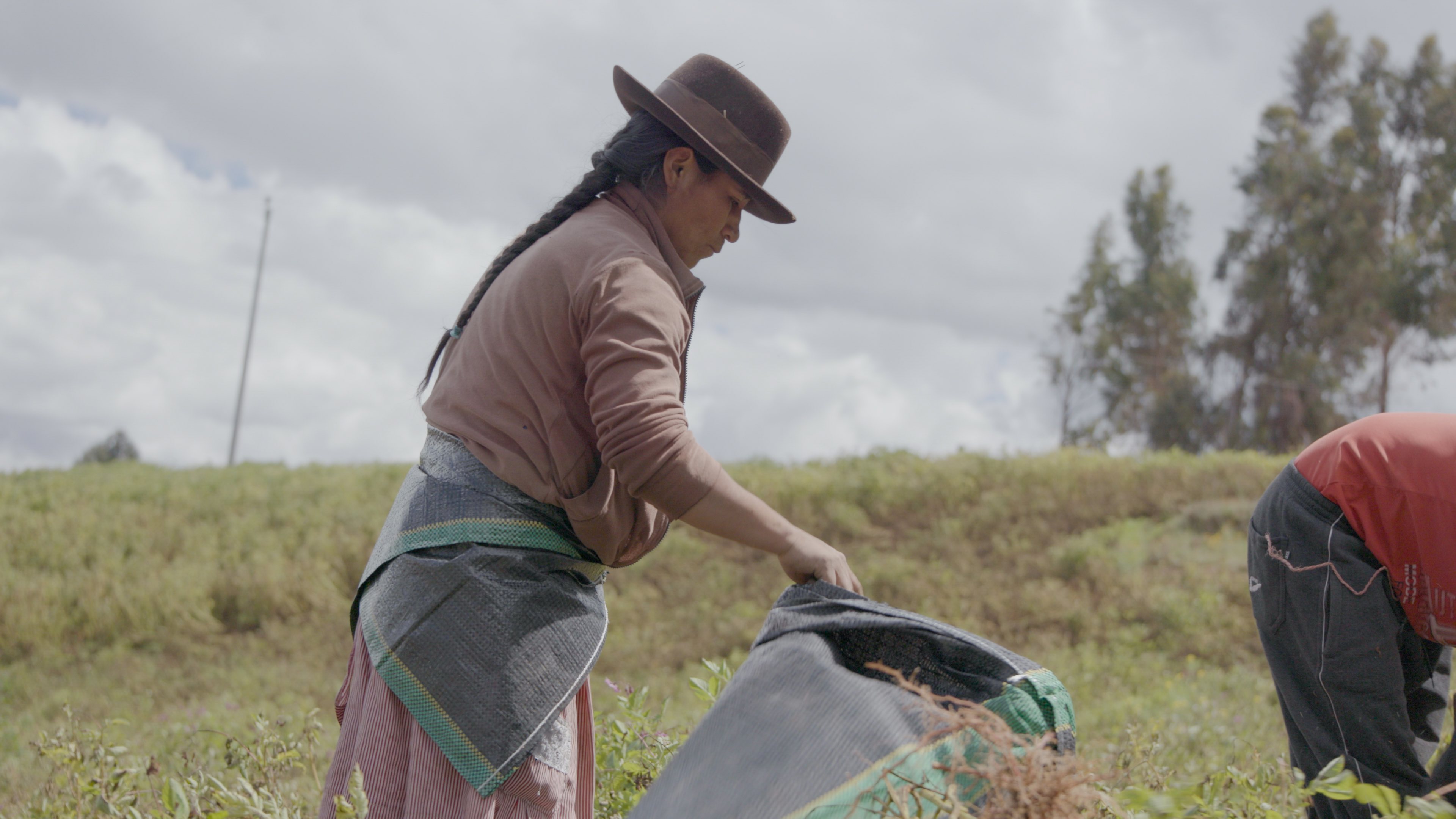
A Quechua farmer in the Andes harvests potatoes
Despite their successes, Ernestine, Tarcila, and Trupti are not receiving the support they need to expand and protect more people from harm. The international community had promised to fund projects like theirs at the 2015 climate negotiations in Paris, but nearly a decade later, communities are still not receiving the support they were promised. In fact, less than one percent of climate finance worldwide supports projects that address both climate and gender equality.
As global temperatures climb, our main characters are desperate to scale their projects. They ask themselves: why would policymakers promise funding and not deliver? Are there genuine issues with delivery, or are intrenched belief systems getting in the way? How can they build their work and influence global politics? In their search for answers, they find others asking the same questions – and organizing for change.
Our film aims to uncover systemic issues with climate finance delivery while showcasing the impact of women-led initiatives. We also aim to document the response from the global feminist community, demanding changes for gender-just finance policies. With storms, droughts, and wildfires increasing in severity, can our protagonists change these systems in time to save their communities? Our film aims to document this movement for climate justice, and we believe it can amplify these essential discussions around climate finance. Will you join us is in making an impact?
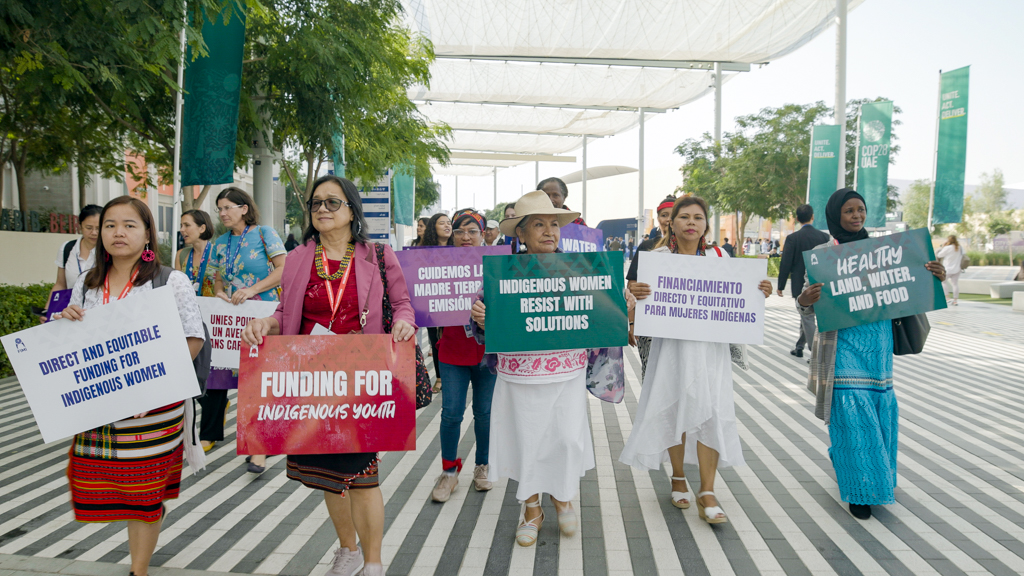
Tarcila Rivera Zea with other women leaders at the UN climate negotiations
Why This Film?
Women are at risk. Climate change is making women's lives harder, right now, across the world. Women already have greater workloads, are paid less, are at greater risk of experiencing violence, and have a harder time gaining access to resources (think land ownership or lines of credit). As storms damage homes, crops fail, and land erodes, these problems are only becoming worse. One proven solution to improving the lives of women and girls is women-led climate action. These are projects that are designed, organized, and led by women to help communities mitigate or adapt to climate change.
100 Ways to Catch the Wind is a story about climate action told through the perspective of women leaders and their communities. Not only is this a story that highlights some of the most incredible climate solutions happening across the world, but it is also an exploration into the relationship between climate finance and climate justice. The film aims to build awareness around the need for climate finance that is transparent and equitable. This film also seeks to explore why women-led climate action is not receiving the funding it needs to scale despite how clear it is that the solutions are clearly useful and valuable.
This film is needed now because it will help draw attention toward what is working, what needs support, and toward those who need support most. This is a film about the power of creativity, community, and solidarity.
Why Our Team?
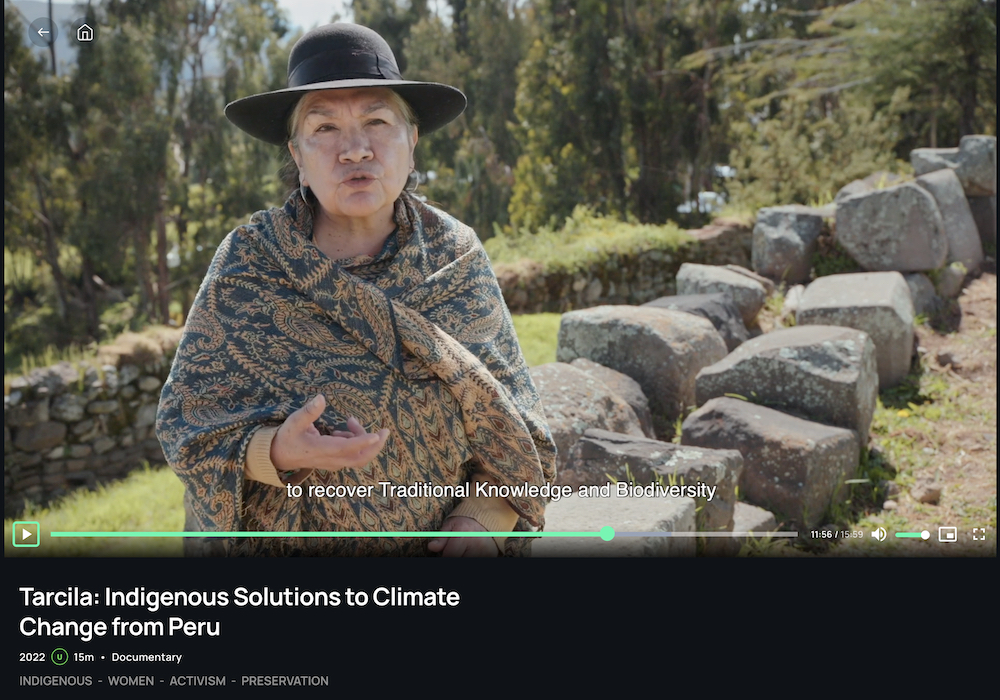
I'm Sarah Kuck, and while researching women’s rights and climate change, I came across the incredible work of the Women’s Environment and Development Organization (WEDO). Their program funding women to travel to climate negotiations captivated me, and I wrote my graduate thesis on their work while transitioning from journalism to documentary film. Through this journey, I connected with Bridget Burns, now WEDO’s executive director, who has been instrumental in supporting this project. In 2018, she introduced me to Tarcila Rivera Zea, and we collaborated on a short film in 2019, currently streaming on Waterbear. Now, we’re pledging to showcase a broader movement through the perspectives of Tarcila, Trupti, and Ernestine, highlighting the resilience and innovation behind their global climate initiatives. The time to share this vital story is now.
Growing up in a military family, I was always on the move, which sparked my curiosity about the meaning of home and belonging. My interest in storytelling revolves around community and relationships. My films – "Even the Walls" (Best Short Film, SIFF, 2015), "Retornados" (IWMF Grantee, 2016), and "Tarcila: Indigenous Solutions to Climate Change from Peru" (Audience Choice Short SFiFF, 2020) – explore external forces that pressure communities to change, such as gentrification, gang violence, or the climate crisis. I'm drawn to stories about how communities evolve, what drives their erasure or displacement, and how new networks are built.
Where We Are and How You Can Help
This year’s global climate talks are rapidly approaching, and our first can't-miss meeting to document is in New York at the United Nations General Assembly in late September. We are crowdfunding to raise funds to travel to New York and film this important event. This footage is essential to documenting the work of our protagonists and the feminist movement for climate justice. Your support will help us share these vital stories and amplify the voices of women leading the fight against climate change. Join us in making this documentary a reality and be part of a movement for global climate justice. We will use any stretch goal funds to continue to produce the film! Our next trip is to COP29 and to India to document Trupti Jain's incredible work expanding the use of water harvesting technology in Gujarat.
All donations are tax deductible through our fiscal sponsorship with Pachamama Sabia.
Wishlist
Use the WishList to Pledge cash and Loan items - or - Make a pledge by selecting an Incentive directly.
Gear
Costs $8,000
We need excellent gear to beautifully document these historic and important efforts!
Location
Costs $1,400
This will support meals, airfare, and transportation.
Crew
Costs $11,000
Help us support our incredible crew!
Lodging
Costs $2,000
We will need somewhere to literally and metaphorically charge our batteries
Cash Pledge
Costs $0


Direct link:
Share this update!
About This Team
I'm Sarah Kuck, and while researching women’s rights and climate change, I came across the incredible work of the Women’s Environment and Development Organization (WEDO). Their program funding women to travel to climate negotiations captivated me, and I wrote my graduate thesis on their work while transitioning from journalism to documentary film. Through this journey, I connected with Bridget Burns, now WEDO’s executive director, who has been instrumental in supporting this project. In 2018, she introduced me to Tarcila Rivera Zea, and we collaborated on a short film in 2019. Now, we’re pledging to showcase a broader movement through the perspectives of Tarcila, Trupti, and Ernestine, highlighting the resilience and innovation behind their global climate initiatives. The time to share this vital story is now.
Sarah Kuck, director
Sarah Kuck is a documentary film director based in Austin, Texas. She grew up in an on-the-move military family, and from an early age became curious about the meaning of home and belonging. She now finds that much of her interest in storytelling revolves around ideas of community and relationship. Her films – Even the Walls (Best Short Film, SIFF, 2015), Retornados (IWMF Grantee, 2016), and Tarcila (Audience Choice Short SFiFF, 2020) – each examine external forces that pressure communities to change, such as gentrification, gang violence, or the climate crisis. In 2017, she founded her production company Present Medium, which has since developed content locally and internationally in cities like San Pedro Sula, Lima, Athens, and Mumbai. Sarah earned her master’s degree in media studies from The New School (2013), and her bachelor’s degree in environmental journalism from Western Washington University (2006).
Natalie Conneely, executive producer
Natalie Conneely is an award winning Bolivian Actor, Producer and Activist based in Los Angeles, CA. Natalie co-wrote and co-directed the Feature Documentary Selva Adentro (2021) and was Executive Producer of Bring Me an Avocado (2019). Natalie Founded Changing Stories to commission storytelling workshops with underserved communities in Bolivia in 2014 and in 2019 in response to the Amazon fires launched Pachamama Sabia, a global social impact production house & creator of Art Awakenings, gatherings and connections to elevate artists and their art towards social good. Natalie is also Co-Founder of the Hollywood Compassion Coalition, a nonprofit entertainment industry movement to bridge science and data for creatives and audiences to gain insight and take action in regards to the impact that stories have on society.
E.J. Enríquez, director of photography
E.J. Enríquez is an Austin, TX based DP whose work encompasses a variety of genres
and formats that have screened around the world. Premieres and showcases include the Sundance, SXSW & Tribeca Film Festivals among others. This life in Film has taken him to 5 continents including Africa, Asia, Europe & South America. Current work is on the festival circuit for the upcoming HBO series “God Save Texas,” having shot an episode with the legendary filmmaker Richard Linklater along with the talented Iliana Sosa. As much as E.J. loves talking about himself (he doesn’t), you can see him chasing light on his Moto Guzzi around town.
Laura Colwell, editor
Laura Colwell is an Austin-based editor and musician. She has over a decade of experience and has worked with Terrence Malick (Voyage of Time), Morrisa Maltz (Ingrid, The Unknown Country, Jazzy), Megalomedia (My 600-Lb Life, Skin Tight), and for AFS supported filmmakers Mike Blizzard (Also Starring Austin) and Karen Skloss (The Honor Farm). Her love of documentary, drama, and comedy, as well as her background in music are blueprints of her craft. Between productions, she spends time performing around the globe with her band.
Brian Ramos, composer + story producer
Brian Ramos began his career as a performing musician before bringing his talents to film and television through composing, production sound, and post-production audio mixing. Among his many credits, Brian served as a lead on the production team for the Emmy-winning PBS series On Story, and produced the nationally syndicated On Story radio show for the Austin Film Festival and Public Radio International. Brian’s work in music, production
sound and post-production audio has included projects for HBO, Showtime, Discovery, Netflix, Bravo, A&E, Meta and the Solomon R. Guggenheim Foundation as well as films for television and the big screen. Brian lives in Austin, Texas where he enjoys spending time with his partner Julie.
Sidrah Fatma Ahmed, producer INDIA
Sidrah Fatma Ahmed is a journalist and documentary filmmaker based in Delhi, India. She has more than a decade of experience in reporting, directing, and producing video content for media networks. Women's stories are at the heart of her work, along with topics of development, at large. Her work has been published in Hindustan Times, Khabar Lahariya, Financial Times, The New York Times, Vox.com, Great Big Story, Bloomberg, and Business Reporter, among others.
Current Team
Incentives
- The Story
- Wishlist
- Updates
- The Team
- Community
Mission Statement
The Story
Join us in making this documentary a reality and be part of a movement for global climate justice. We will use any stretch goal funds to continue to produce the film! Our next trip is to COP29 and to India to document Trupti Jain's incredible work expanding the use of water harvesting technology in Gujarat. All donations are tax deductible through our fiscal sponsorship with Pachamama Sabia.
100 Ways to Catch the Wind Teaser
100 Ways to Catch the Wind is a feature-length documentary about three women taking their climate activism from their local and Indigenous communities to the global stage. They’re fighting for support for their life-saving projects, and we need your help to document their efforts.
In the Peruvian Andes, Tarcila Rivera Zea's Indigenous Rights organization is empowering farmers to revive ancient, drought-resistant seed varieties. In Western India, Trupti Jain co-created a device to store excess flood water for later use, and now she’s working with women farmers to improve its design and expand its impact. And in the forests of Cameroon, Ernestine Leikeki Sevidzem is helping women combat bushfires and earn a living through tree planting and agroforestry.
We follow Ernestine, Tarcila, and Trupti as they meet with women from their communities, who share how climate events affect their lives and livelihoods. Through their day-to-day efforts and group meetings, these women show us how their projects are creating economic impact, boosting their power in decision-making spaces, and improving safety.
A Quechua farmer in the Andes harvests potatoes
Despite their successes, Ernestine, Tarcila, and Trupti are not receiving the support they need to expand and protect more people from harm. The international community had promised to fund projects like theirs at the 2015 climate negotiations in Paris, but nearly a decade later, communities are still not receiving the support they were promised. In fact, less than one percent of climate finance worldwide supports projects that address both climate and gender equality.
As global temperatures climb, our main characters are desperate to scale their projects. They ask themselves: why would policymakers promise funding and not deliver? Are there genuine issues with delivery, or are intrenched belief systems getting in the way? How can they build their work and influence global politics? In their search for answers, they find others asking the same questions – and organizing for change.
Our film aims to uncover systemic issues with climate finance delivery while showcasing the impact of women-led initiatives. We also aim to document the response from the global feminist community, demanding changes for gender-just finance policies. With storms, droughts, and wildfires increasing in severity, can our protagonists change these systems in time to save their communities? Our film aims to document this movement for climate justice, and we believe it can amplify these essential discussions around climate finance. Will you join us is in making an impact?
Tarcila Rivera Zea with other women leaders at the UN climate negotiations
Why This Film?
Women are at risk. Climate change is making women's lives harder, right now, across the world. Women already have greater workloads, are paid less, are at greater risk of experiencing violence, and have a harder time gaining access to resources (think land ownership or lines of credit). As storms damage homes, crops fail, and land erodes, these problems are only becoming worse. One proven solution to improving the lives of women and girls is women-led climate action. These are projects that are designed, organized, and led by women to help communities mitigate or adapt to climate change.
100 Ways to Catch the Wind is a story about climate action told through the perspective of women leaders and their communities. Not only is this a story that highlights some of the most incredible climate solutions happening across the world, but it is also an exploration into the relationship between climate finance and climate justice. The film aims to build awareness around the need for climate finance that is transparent and equitable. This film also seeks to explore why women-led climate action is not receiving the funding it needs to scale despite how clear it is that the solutions are clearly useful and valuable.
This film is needed now because it will help draw attention toward what is working, what needs support, and toward those who need support most. This is a film about the power of creativity, community, and solidarity.
Why Our Team?
I'm Sarah Kuck, and while researching women’s rights and climate change, I came across the incredible work of the Women’s Environment and Development Organization (WEDO). Their program funding women to travel to climate negotiations captivated me, and I wrote my graduate thesis on their work while transitioning from journalism to documentary film. Through this journey, I connected with Bridget Burns, now WEDO’s executive director, who has been instrumental in supporting this project. In 2018, she introduced me to Tarcila Rivera Zea, and we collaborated on a short film in 2019, currently streaming on Waterbear. Now, we’re pledging to showcase a broader movement through the perspectives of Tarcila, Trupti, and Ernestine, highlighting the resilience and innovation behind their global climate initiatives. The time to share this vital story is now.
Growing up in a military family, I was always on the move, which sparked my curiosity about the meaning of home and belonging. My interest in storytelling revolves around community and relationships. My films – "Even the Walls" (Best Short Film, SIFF, 2015), "Retornados" (IWMF Grantee, 2016), and "Tarcila: Indigenous Solutions to Climate Change from Peru" (Audience Choice Short SFiFF, 2020) – explore external forces that pressure communities to change, such as gentrification, gang violence, or the climate crisis. I'm drawn to stories about how communities evolve, what drives their erasure or displacement, and how new networks are built.
Where We Are and How You Can Help
This year’s global climate talks are rapidly approaching, and our first can't-miss meeting to document is in New York at the United Nations General Assembly in late September. We are crowdfunding to raise funds to travel to New York and film this important event. This footage is essential to documenting the work of our protagonists and the feminist movement for climate justice. Your support will help us share these vital stories and amplify the voices of women leading the fight against climate change. Join us in making this documentary a reality and be part of a movement for global climate justice. We will use any stretch goal funds to continue to produce the film! Our next trip is to COP29 and to India to document Trupti Jain's incredible work expanding the use of water harvesting technology in Gujarat.
All donations are tax deductible through our fiscal sponsorship with Pachamama Sabia.
Wishlist
Use the WishList to Pledge cash and Loan items - or - Make a pledge by selecting an Incentive directly.
Gear
Costs $8,000
We need excellent gear to beautifully document these historic and important efforts!
Location
Costs $1,400
This will support meals, airfare, and transportation.
Crew
Costs $11,000
Help us support our incredible crew!
Lodging
Costs $2,000
We will need somewhere to literally and metaphorically charge our batteries
Cash Pledge
Costs $0
Direct link:
Share this update!
About This Team
I'm Sarah Kuck, and while researching women’s rights and climate change, I came across the incredible work of the Women’s Environment and Development Organization (WEDO). Their program funding women to travel to climate negotiations captivated me, and I wrote my graduate thesis on their work while transitioning from journalism to documentary film. Through this journey, I connected with Bridget Burns, now WEDO’s executive director, who has been instrumental in supporting this project. In 2018, she introduced me to Tarcila Rivera Zea, and we collaborated on a short film in 2019. Now, we’re pledging to showcase a broader movement through the perspectives of Tarcila, Trupti, and Ernestine, highlighting the resilience and innovation behind their global climate initiatives. The time to share this vital story is now.
Sarah Kuck, director
Sarah Kuck is a documentary film director based in Austin, Texas. She grew up in an on-the-move military family, and from an early age became curious about the meaning of home and belonging. She now finds that much of her interest in storytelling revolves around ideas of community and relationship. Her films – Even the Walls (Best Short Film, SIFF, 2015), Retornados (IWMF Grantee, 2016), and Tarcila (Audience Choice Short SFiFF, 2020) – each examine external forces that pressure communities to change, such as gentrification, gang violence, or the climate crisis. In 2017, she founded her production company Present Medium, which has since developed content locally and internationally in cities like San Pedro Sula, Lima, Athens, and Mumbai. Sarah earned her master’s degree in media studies from The New School (2013), and her bachelor’s degree in environmental journalism from Western Washington University (2006).
Natalie Conneely, executive producer
Natalie Conneely is an award winning Bolivian Actor, Producer and Activist based in Los Angeles, CA. Natalie co-wrote and co-directed the Feature Documentary Selva Adentro (2021) and was Executive Producer of Bring Me an Avocado (2019). Natalie Founded Changing Stories to commission storytelling workshops with underserved communities in Bolivia in 2014 and in 2019 in response to the Amazon fires launched Pachamama Sabia, a global social impact production house & creator of Art Awakenings, gatherings and connections to elevate artists and their art towards social good. Natalie is also Co-Founder of the Hollywood Compassion Coalition, a nonprofit entertainment industry movement to bridge science and data for creatives and audiences to gain insight and take action in regards to the impact that stories have on society.
E.J. Enríquez, director of photography
E.J. Enríquez is an Austin, TX based DP whose work encompasses a variety of genres
and formats that have screened around the world. Premieres and showcases include the Sundance, SXSW & Tribeca Film Festivals among others. This life in Film has taken him to 5 continents including Africa, Asia, Europe & South America. Current work is on the festival circuit for the upcoming HBO series “God Save Texas,” having shot an episode with the legendary filmmaker Richard Linklater along with the talented Iliana Sosa. As much as E.J. loves talking about himself (he doesn’t), you can see him chasing light on his Moto Guzzi around town.
Laura Colwell, editor
Laura Colwell is an Austin-based editor and musician. She has over a decade of experience and has worked with Terrence Malick (Voyage of Time), Morrisa Maltz (Ingrid, The Unknown Country, Jazzy), Megalomedia (My 600-Lb Life, Skin Tight), and for AFS supported filmmakers Mike Blizzard (Also Starring Austin) and Karen Skloss (The Honor Farm). Her love of documentary, drama, and comedy, as well as her background in music are blueprints of her craft. Between productions, she spends time performing around the globe with her band.
Brian Ramos, composer + story producer
Brian Ramos began his career as a performing musician before bringing his talents to film and television through composing, production sound, and post-production audio mixing. Among his many credits, Brian served as a lead on the production team for the Emmy-winning PBS series On Story, and produced the nationally syndicated On Story radio show for the Austin Film Festival and Public Radio International. Brian’s work in music, production
sound and post-production audio has included projects for HBO, Showtime, Discovery, Netflix, Bravo, A&E, Meta and the Solomon R. Guggenheim Foundation as well as films for television and the big screen. Brian lives in Austin, Texas where he enjoys spending time with his partner Julie.
Sidrah Fatma Ahmed, producer INDIA
Sidrah Fatma Ahmed is a journalist and documentary filmmaker based in Delhi, India. She has more than a decade of experience in reporting, directing, and producing video content for media networks. Women's stories are at the heart of her work, along with topics of development, at large. Her work has been published in Hindustan Times, Khabar Lahariya, Financial Times, The New York Times, Vox.com, Great Big Story, Bloomberg, and Business Reporter, among others.