Staring at the Dark
Panama City, Florida | Film Feature
Documentary, Experimental
Bay Harbor residents remember life in a historic Black community after a hurricane in Panama City, Florida. Disaster is just the beginning.
Staring at the Dark
Panama City, Florida | Film Feature
Documentary, Experimental

1 Campaigns | Illinois, United States
Green Light
This campaign raised $10,652 for production. Follow the filmmaker to receive future updates on this project.
46 supporters | followers
Enter the amount you would like to pledge
Bay Harbor residents remember life in a historic Black community after a hurricane in Panama City, Florida. Disaster is just the beginning.
About The Project


- The Story
- Wishlist
- Updates
- The Team
- Community
Mission Statement
The Story
Black communities in the Southeast face more displacement and property damage as they are 1.8 times more likely than others in the same area to be hit by hurricanes. Staring at the Dark is a socially engaged, experimental documentary film and community project about Black ancestral and contemporary landscapes in the age of environmental catastrophe. Incorporating oral histories, digital projections, and sculptural installations of rebuilt sites now lost, this project reveals the unseen as a way of practicing sustained care and illuminating the spirit of revival in Black communities.
Staring at the Dark uses an experimental approach to filming the landscape and follows community members from Bay Harbor, a historic African American neighborhood near Panama City, Florida established when rural land workers migrated to urban centers to work the timber and chemical refining industries. This community grew to provide care for every aspect of Black life from spiritual gatherings and civic organizing to entertainment and domestic life. Staring at the Dark carefully renders fragments of daily life more than five years after a category five hurricane, drawing inspiration from the landscape to tell the story of six sites now lost. The technical and artistic treatment for this documentary will use a mixed media - archival footage, digital and film formats - as well as a visual story for each of these sites in the form of miniatures made of sugarcane paper, a process which is meant to reveal the complexities of rebuilding places and community archives after long standing historical inequities: from housing displacement, to school closures, and environmental racism.
With increasingly severe and frequent weather events in Florida, each time disaster strikes, historic communities like this one must decide how they will survive, preserve their cultural history, and rebuild a future in an increasingly uncertain time and place.
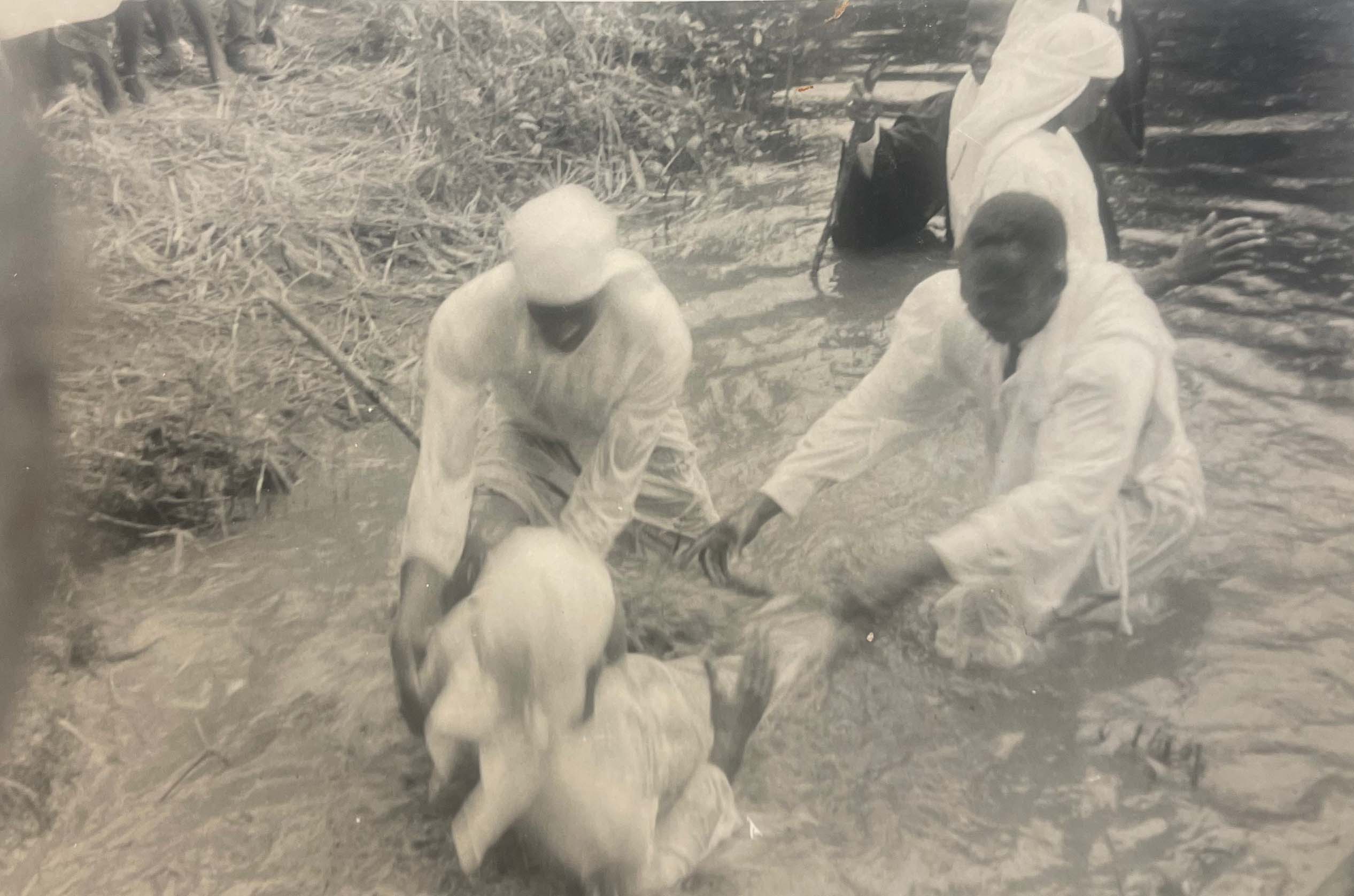
Image Caption: An archival photograph of African American church congregants being baptized in the "bayou" in the historic area known as Bay Harbor. Image Credit: Unknown
Why am I telling this story? Why now?
This project was inspired by my experience during the pandemic spending stay-at-home orders with family in my hometown of Panama City, Florida. While working on multiple community-focused projects in Chicago, I was also becoming reacquainted with my hometown, a place in Florida’s coastal panhandle where just over a year had passed since Hurricane Michael damaged or destroyed entire neighborhoods across the city. When the national media coverage vanished after a few days, record numbers of people were still navigating the crisis for months; and many still do today.

Image caption: A behind the scenes still image from the film Staring at the Dark showing the director, Leah Gipson and her father, John Gipson. Image Credit: Joel Wanek
As a socially engaged artist, I started collecting stories from community members about the experiences, memories, and absences they were feeling across the hurricane-ripped landscape. I focused particularly on Black residents and their descendants, beginning with a historically segregated community known as Bay Harbor.
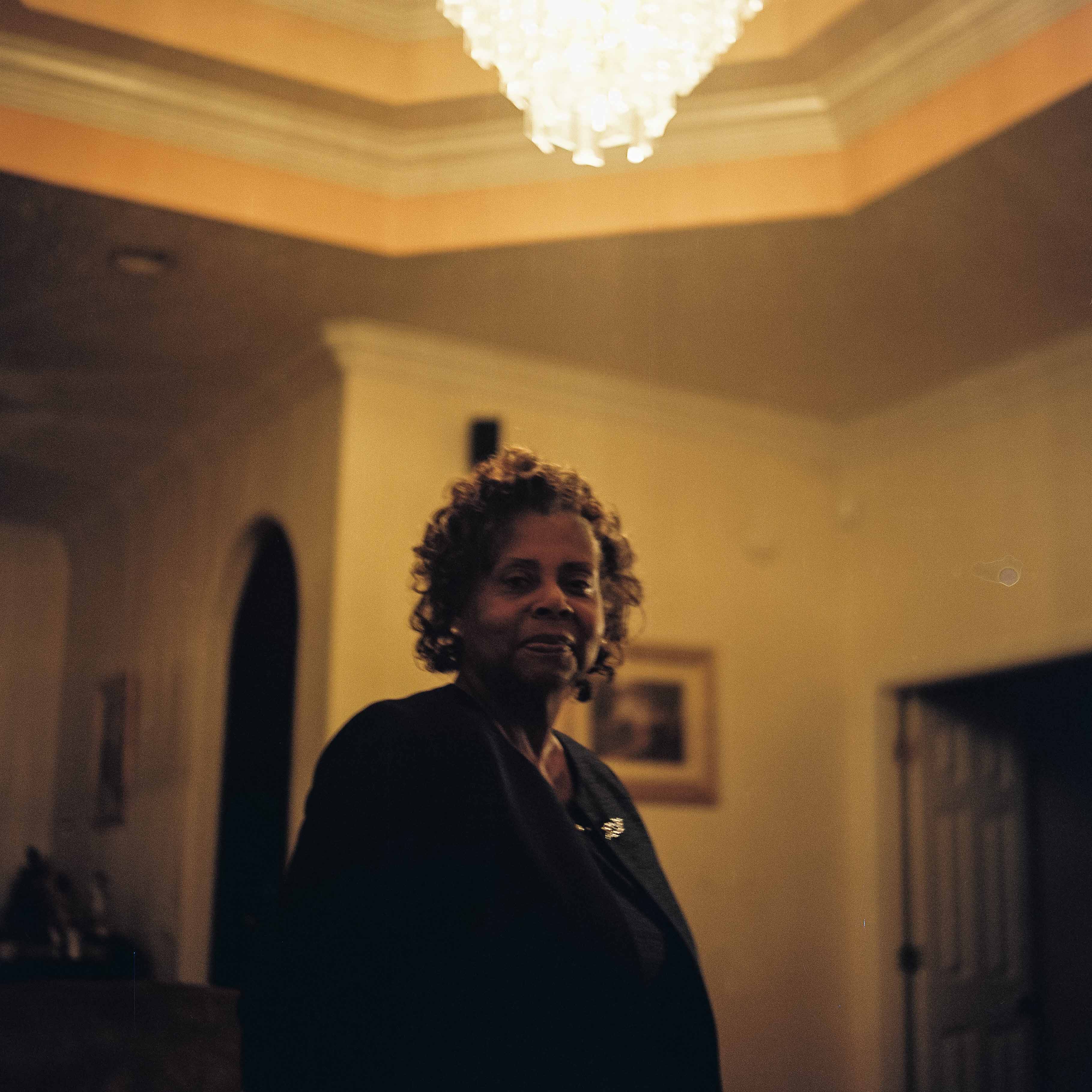
Image caption: A behind the scenes photograph from the film Staring at the Dark shows Dr. Anita Carlisle Dillard of Bay Harbor. Image Credit: Dwayne Young
I decided to develop Staring at the Dark as a community archiving project and a landscape documentary film as a way to tell the story of African American migration in Florida and post-disaster community resilience. This film is important now as the work of preparing for and recovering from environmental disaster is ongoing in this city, and everywhere. The community impact of this project will allow generations of residents from Bay Harbor to participate in communal storytelling, rebuild family photo and home movie collections, and cultivate post-disaster resilience in the area.
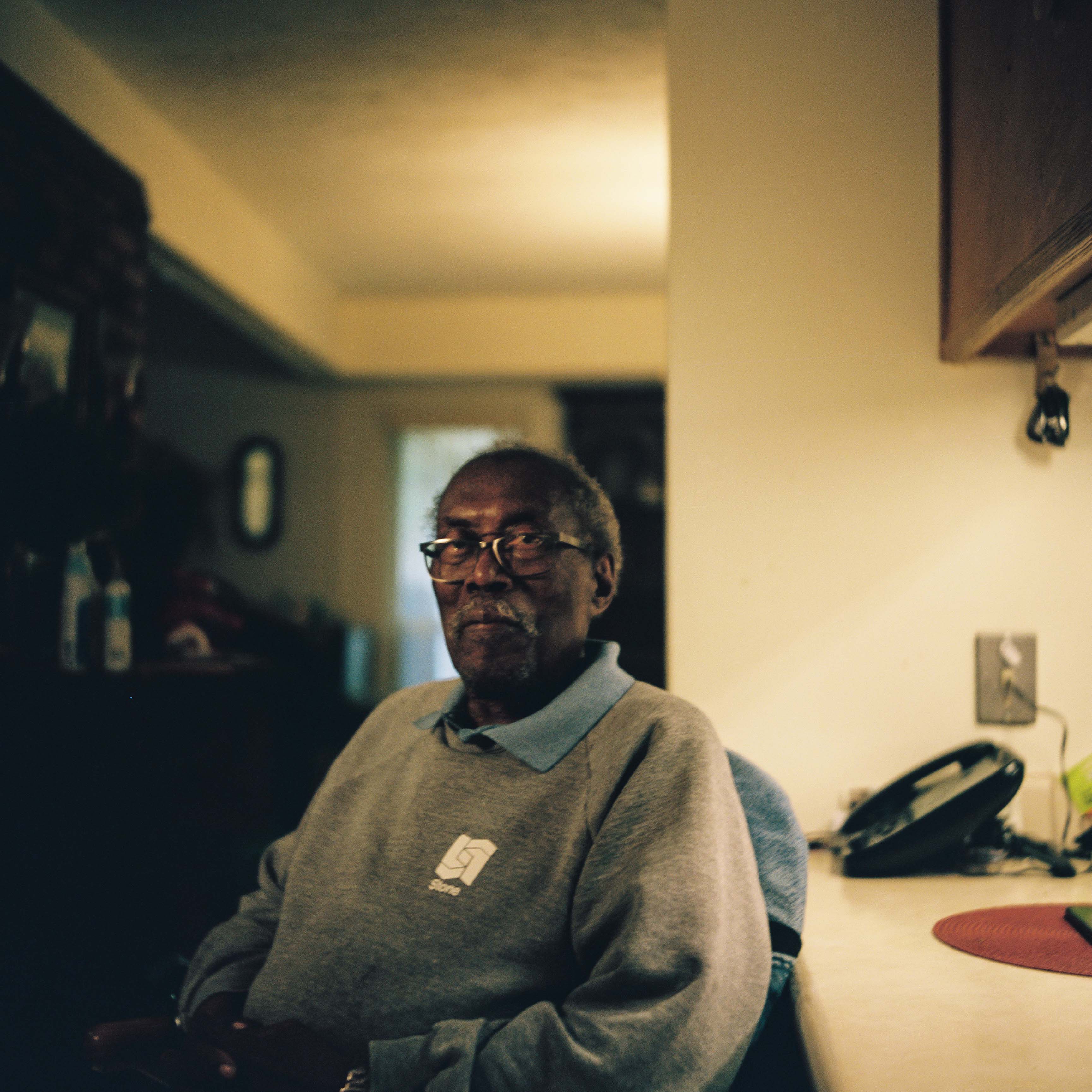
Image caption: A behind the scenes photograph from the film Staring at the Dark shows Curtis Hodge of Bay Harbor. Image Credit: Dwayne Young
How and when will the campaign funds support the project?
We are preparing for production June 19-23, 2025 in Panama City, Florida. We'll be filming evening and nighttime landscapes, as well as a pop-up video projection installation in a post-hurricane vacant site featured in Staring at the Dark. These evening shoots require professional lighting and camera, and a talented crew. We have received initial funding from Creative Capital and during our campaign with 3Arts Chicago reached half of our stretch goal. We need your support to reach the remainder of our annual fundraising goal that will make this summer 2025 film shoot possible. Thank you to all of our supporters who have made it possible for us to make this project known and legible to more contributors like you.
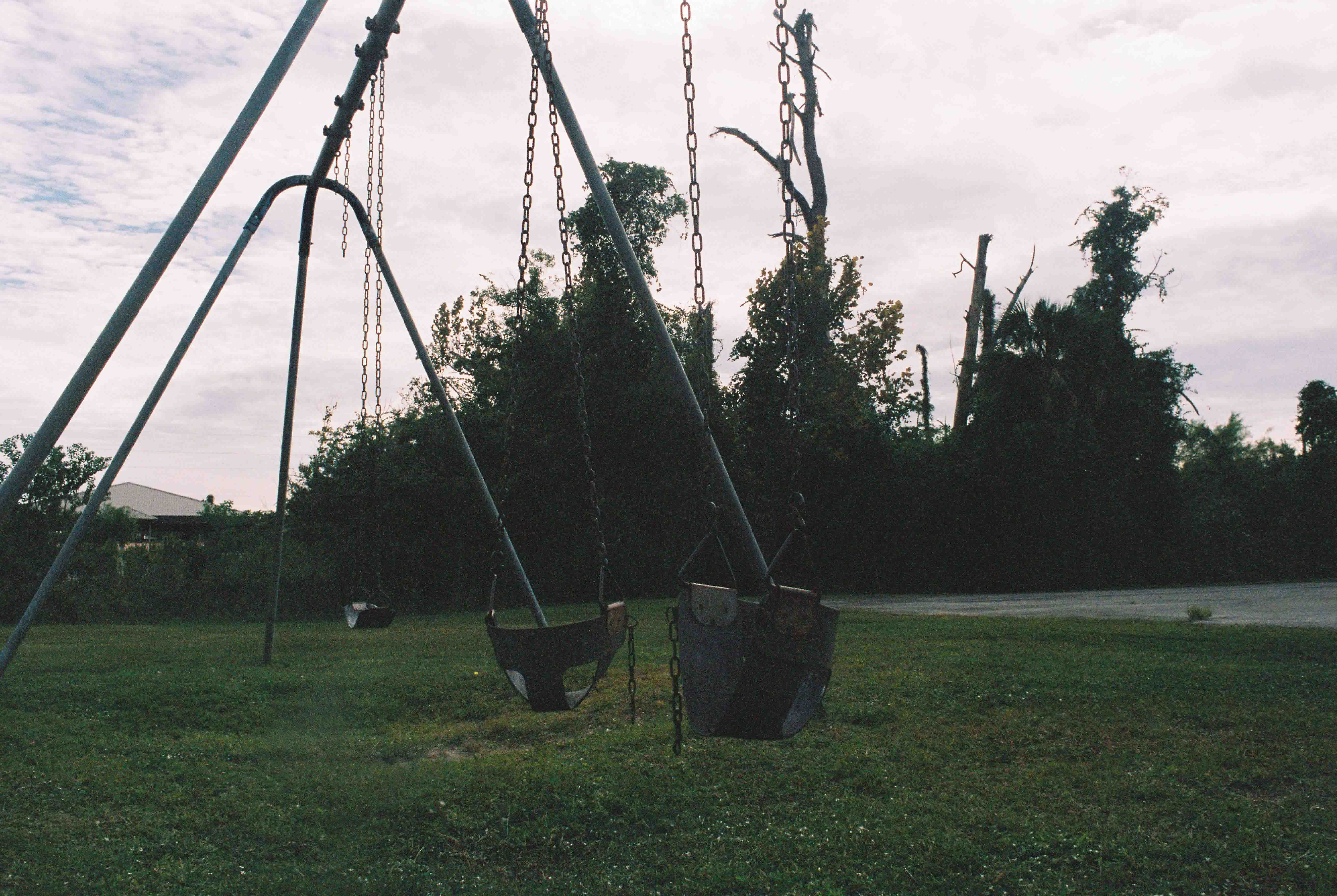
Image caption: A behind the scenes photograph from the film Staring at the Dark shows rusted swings at the city park in the historic area known as Bay Harbor. Image Credit: Dwayne Young
How can you support?
We are so immensely grateful for your support in bringing each phase of this documentary film to life. You can continue to support us by pledging at any level of contribution, and sending a personal text to friends and family to share this campaign. Follow our team on social media during the campaign @leahra.chel on IG and share your own posts to help us reach our goal. We look forward to sharing updates about the project with you at each stage, and will be sure to contact you when the documentary is complete and available to view.
Wishlist
Use the WishList to Pledge cash and Loan items - or - Make a pledge by selecting an Incentive directly.
1-Day Camera Crew (Combined Per Day Rates)
Costs $1,700
A day of work with a small camera crew: DP, Camera Operator, Assistant Camera
1-Day Rental ARRI Alexa Camera Package
Costs $1,000
We will be using a large digital cinema camera to film sunset and nighttime landscapes and an video projection installation.
1-Night 4 Hotel Rooms for Crew
Costs $600
Panama City is a small city on the coast of Northwest Florida. Our crew is a combination of local and long-distance talent.
1-Day Food and Craft Services (snacks)
Costs $250
Crew meals, snacks, and water provided during the film shoot
Crew Airfare
Costs $2,500
Our long-distance crew members will travel from Chicago, New York, and Berkeley to Panama City, Florida
SD Cards, Project Drives, and Backup Drives
Costs $800
This film uses multiple media formats, digital and film. Each day of the shoot, digital footage will be downloaded and stored to drives.
16mm Camera with Kodak Film Cans
Costs $1,200
This film uses multiple media formats, including Kodak 16 mm film.
1-Week Rental Sachtler or Oconnor Tripod
Costs $700
We are using a heavy duty tripod designed for the weight of a large digital camera and lens to film scenes at night.
1-Week Rental Sigma Art Prime Lenses
Costs $600
Cinematic lenses for low light
1-Day Gaffer with Lighting Package
Costs $1,500
We will use lighting for an outdoor evening and nighttime focused film shoot.
1-Day Sound Crew with Equipment
Costs $600
1 sound mixer with equipment
1-Day Production Assistant
Costs $120
A production assistant supports the production crew during the film shoot by ordering meals, helping with transportation, and crew needs.
Cash Pledge
Costs $0


Direct link:
Share this update!
About This Team
My name is Leah Ra'chel Gipson (she/her), I am the director/producer of the upcoming experimental documentary film Staring at the Dark. I am a multidisciplinary artist and scholar based in Panama City, Florida, and Chicago, Illinois. My work as an artist facilitates hyperlocal, community projects that engage Black culture and imagines critical “call and response” environments. I explore issues of race and gender through family history, popular media, and archives using image, sound, textile, installation, and film. I am an Associate Professor at the School of the Art Institute of Chicago in the Art Therapy and Counseling Department. My work has been featured at the South Side Community Art Center, Jane Addams Hull-House Museum, the Museum of Contemporary Art Chicago, Netflix Queue, Project Row Houses, Nawat Fes, Morocco, and the Central Academy of Fine Arts, Beijing. I was awarded a 2024 Creative Capital Award for the project Staring at the Dark.
I am working with Imani Nikyah Dennison (she/they), an award-winning filmmaker born in Louisville, Kentucky, who shares an interest in histories of Black culture in the South and the African diaspora. Imani Dennison is a multidisciplinary artist, and curator. Imani graduated from Howard University where they studied Political Science and Photography. Imani’s work interrogates histories of Black culture in the South and African diaspora, usually centered in folklore, fantasy, and hidden histories. Imani is a 2023 Flaherty curator fellow and head Programmer at Black Science Fiction; a Black led creative experiment dedicated to the preservation of Black imagination. Imani has created commissioned documentary works for PBS, Tribeca, ITVS, and Proctor & Gamble. Imani is a part of the 2022 Tribeca Queen Collective Directing Program where they recently released their latest film, Bone Black: Midwives vs the South that made its international premier at the Tribeca Film Festival. This work has gone on to win Best Short Documentary at both the 2023 Black Star Film festival and New Orleans Film festival. Imani is currently a 2023 Chicken & Egg/POV grant recipient allowing them to advance on finishing their short creative non-fiction film, The People Could Fly about the ritual of roller skating and how roller rinks emerged as sanctuaries for Black culture in Louisville, Kentucky.
My dad, John Gipson (he/him) is also an important collaborator. His relationships with his siblings, cousins, church family, neighbors, and childhood friends ground the work in community building after Hurricane Michael. He is also knowledgeable about growing food, and he planted the sugarcane for the project. We are working to build local partnerships with the county library, higher education institutions, organizations, and local artists, educators, and public officials about integrating this project into larger efforts in the area to preserve African American history and culture.
Joel Wanek (he/him) is a film and audio artist working in the realms of creative non-fiction. Over the years, he has developed a practice that celebrates and investigates spatial poetics, racial dynamics, and the immaterial possibilities of sound and image. His film work has screened internationally at venues such as International Film Festival Rotterdam, ICA London, Union Docs, Doclisboa, Images Festival, and Winterthur. His film Sun Song won top prizes at International Short Film Festival Hamburg, ICDOCS, and FCDEP. It also won Best Cinematography at the Ann Arbor Film Festival and is distributed worldwide by MUBI. In a previous life, Joel was a video journalist producing the Emmy Award winning video series Art School for KQED/PBS in San Francisco and creating other unscripted work for NY Times, AJ+, Now This News, PBS NewsHour, and the ACLU.
Jordan Marking (he/him) has been working and learning on set for over twenty years, and is the owner of the production company Three Part Films in Panama City, Florida. This is his dream job, his career, and has always been his plan. Jordan is driven by faith and family to give one hundred and ten percent when he produces videos and collaborates with other filmmakers.
Eliyannah Yisrael (she/her) graduated from Chicago State University with a BA in Communications, Media Arts and Theatre. In addition to producing and directing independent projects for over 10 years, Eliyannah has worked on films and episodic material for Sony, FOX, NBC, HBO, Lionsgate, ABC/Disney, and Warner Brothers among others. She has directed the short films, “The Life I Carry”, “The Weight of Sadness”, “How We Flew Across the Water” and “We Love Us Cause Ya’ll Won’t”; the digital pilots, “Tuesdays @ 4” and “Lies & Lipstick, as well as creating and directing 12 episodes of the webseries, “Hermione Granger and the Quarter Life Crisis”. In 2021, Eliyannah directed the urban, coming-of-age feature film, “Loud Burger”. She’s a Black girl from the south side of Chicago who was supposed to stay inside her box. Instead, she decided to dream big and change the world through visual storytelling. Eliyannah seeks to continue telling stories centered around Black women and other people of color.
Terence Sims (he/him) is an actor and producer born and raised in Maywood, IL, a suburb just west of Chicago. He has studied American Theatre Arts at Rose Bruford College in London and is a graduate of Columbia College Chicago. Television credits include: Chicago PD(NBC); Med(NBC); and 4400(CW) and his talents have been displayed on the stages of Steppenwolf Theatre and the Goodman Theatre in Chicago, B Street Theatre in Sacramento, and the Children's Theater of Madison. Terence is a proud member of SAG/Aftra, Actor's Equity, and Kinfolk Collective, an afrofuturist aesthetic tribe of artists and scholars working to rewrite and remaster the narrative of members of the African diaspora.
Current Team
Incentives
- The Story
- Wishlist
- Updates
- The Team
- Community
Mission Statement
The Story
Black communities in the Southeast face more displacement and property damage as they are 1.8 times more likely than others in the same area to be hit by hurricanes. Staring at the Dark is a socially engaged, experimental documentary film and community project about Black ancestral and contemporary landscapes in the age of environmental catastrophe. Incorporating oral histories, digital projections, and sculptural installations of rebuilt sites now lost, this project reveals the unseen as a way of practicing sustained care and illuminating the spirit of revival in Black communities.
Staring at the Dark uses an experimental approach to filming the landscape and follows community members from Bay Harbor, a historic African American neighborhood near Panama City, Florida established when rural land workers migrated to urban centers to work the timber and chemical refining industries. This community grew to provide care for every aspect of Black life from spiritual gatherings and civic organizing to entertainment and domestic life. Staring at the Dark carefully renders fragments of daily life more than five years after a category five hurricane, drawing inspiration from the landscape to tell the story of six sites now lost. The technical and artistic treatment for this documentary will use a mixed media - archival footage, digital and film formats - as well as a visual story for each of these sites in the form of miniatures made of sugarcane paper, a process which is meant to reveal the complexities of rebuilding places and community archives after long standing historical inequities: from housing displacement, to school closures, and environmental racism.
With increasingly severe and frequent weather events in Florida, each time disaster strikes, historic communities like this one must decide how they will survive, preserve their cultural history, and rebuild a future in an increasingly uncertain time and place.
Image Caption: An archival photograph of African American church congregants being baptized in the "bayou" in the historic area known as Bay Harbor. Image Credit: Unknown
Why am I telling this story? Why now?
This project was inspired by my experience during the pandemic spending stay-at-home orders with family in my hometown of Panama City, Florida. While working on multiple community-focused projects in Chicago, I was also becoming reacquainted with my hometown, a place in Florida’s coastal panhandle where just over a year had passed since Hurricane Michael damaged or destroyed entire neighborhoods across the city. When the national media coverage vanished after a few days, record numbers of people were still navigating the crisis for months; and many still do today.
Image caption: A behind the scenes still image from the film Staring at the Dark showing the director, Leah Gipson and her father, John Gipson. Image Credit: Joel Wanek
As a socially engaged artist, I started collecting stories from community members about the experiences, memories, and absences they were feeling across the hurricane-ripped landscape. I focused particularly on Black residents and their descendants, beginning with a historically segregated community known as Bay Harbor.
Image caption: A behind the scenes photograph from the film Staring at the Dark shows Dr. Anita Carlisle Dillard of Bay Harbor. Image Credit: Dwayne Young
I decided to develop Staring at the Dark as a community archiving project and a landscape documentary film as a way to tell the story of African American migration in Florida and post-disaster community resilience. This film is important now as the work of preparing for and recovering from environmental disaster is ongoing in this city, and everywhere. The community impact of this project will allow generations of residents from Bay Harbor to participate in communal storytelling, rebuild family photo and home movie collections, and cultivate post-disaster resilience in the area.
Image caption: A behind the scenes photograph from the film Staring at the Dark shows Curtis Hodge of Bay Harbor. Image Credit: Dwayne Young
How and when will the campaign funds support the project?
We are preparing for production June 19-23, 2025 in Panama City, Florida. We'll be filming evening and nighttime landscapes, as well as a pop-up video projection installation in a post-hurricane vacant site featured in Staring at the Dark. These evening shoots require professional lighting and camera, and a talented crew. We have received initial funding from Creative Capital and during our campaign with 3Arts Chicago reached half of our stretch goal. We need your support to reach the remainder of our annual fundraising goal that will make this summer 2025 film shoot possible. Thank you to all of our supporters who have made it possible for us to make this project known and legible to more contributors like you.
Image caption: A behind the scenes photograph from the film Staring at the Dark shows rusted swings at the city park in the historic area known as Bay Harbor. Image Credit: Dwayne Young
How can you support?
We are so immensely grateful for your support in bringing each phase of this documentary film to life. You can continue to support us by pledging at any level of contribution, and sending a personal text to friends and family to share this campaign. Follow our team on social media during the campaign @leahra.chel on IG and share your own posts to help us reach our goal. We look forward to sharing updates about the project with you at each stage, and will be sure to contact you when the documentary is complete and available to view.
Wishlist
Use the WishList to Pledge cash and Loan items - or - Make a pledge by selecting an Incentive directly.
1-Day Camera Crew (Combined Per Day Rates)
Costs $1,700
A day of work with a small camera crew: DP, Camera Operator, Assistant Camera
1-Day Rental ARRI Alexa Camera Package
Costs $1,000
We will be using a large digital cinema camera to film sunset and nighttime landscapes and an video projection installation.
1-Night 4 Hotel Rooms for Crew
Costs $600
Panama City is a small city on the coast of Northwest Florida. Our crew is a combination of local and long-distance talent.
1-Day Food and Craft Services (snacks)
Costs $250
Crew meals, snacks, and water provided during the film shoot
Crew Airfare
Costs $2,500
Our long-distance crew members will travel from Chicago, New York, and Berkeley to Panama City, Florida
SD Cards, Project Drives, and Backup Drives
Costs $800
This film uses multiple media formats, digital and film. Each day of the shoot, digital footage will be downloaded and stored to drives.
16mm Camera with Kodak Film Cans
Costs $1,200
This film uses multiple media formats, including Kodak 16 mm film.
1-Week Rental Sachtler or Oconnor Tripod
Costs $700
We are using a heavy duty tripod designed for the weight of a large digital camera and lens to film scenes at night.
1-Week Rental Sigma Art Prime Lenses
Costs $600
Cinematic lenses for low light
1-Day Gaffer with Lighting Package
Costs $1,500
We will use lighting for an outdoor evening and nighttime focused film shoot.
1-Day Sound Crew with Equipment
Costs $600
1 sound mixer with equipment
1-Day Production Assistant
Costs $120
A production assistant supports the production crew during the film shoot by ordering meals, helping with transportation, and crew needs.
Cash Pledge
Costs $0
Direct link:
Share this update!
About This Team
My name is Leah Ra'chel Gipson (she/her), I am the director/producer of the upcoming experimental documentary film Staring at the Dark. I am a multidisciplinary artist and scholar based in Panama City, Florida, and Chicago, Illinois. My work as an artist facilitates hyperlocal, community projects that engage Black culture and imagines critical “call and response” environments. I explore issues of race and gender through family history, popular media, and archives using image, sound, textile, installation, and film. I am an Associate Professor at the School of the Art Institute of Chicago in the Art Therapy and Counseling Department. My work has been featured at the South Side Community Art Center, Jane Addams Hull-House Museum, the Museum of Contemporary Art Chicago, Netflix Queue, Project Row Houses, Nawat Fes, Morocco, and the Central Academy of Fine Arts, Beijing. I was awarded a 2024 Creative Capital Award for the project Staring at the Dark.
I am working with Imani Nikyah Dennison (she/they), an award-winning filmmaker born in Louisville, Kentucky, who shares an interest in histories of Black culture in the South and the African diaspora. Imani Dennison is a multidisciplinary artist, and curator. Imani graduated from Howard University where they studied Political Science and Photography. Imani’s work interrogates histories of Black culture in the South and African diaspora, usually centered in folklore, fantasy, and hidden histories. Imani is a 2023 Flaherty curator fellow and head Programmer at Black Science Fiction; a Black led creative experiment dedicated to the preservation of Black imagination. Imani has created commissioned documentary works for PBS, Tribeca, ITVS, and Proctor & Gamble. Imani is a part of the 2022 Tribeca Queen Collective Directing Program where they recently released their latest film, Bone Black: Midwives vs the South that made its international premier at the Tribeca Film Festival. This work has gone on to win Best Short Documentary at both the 2023 Black Star Film festival and New Orleans Film festival. Imani is currently a 2023 Chicken & Egg/POV grant recipient allowing them to advance on finishing their short creative non-fiction film, The People Could Fly about the ritual of roller skating and how roller rinks emerged as sanctuaries for Black culture in Louisville, Kentucky.
My dad, John Gipson (he/him) is also an important collaborator. His relationships with his siblings, cousins, church family, neighbors, and childhood friends ground the work in community building after Hurricane Michael. He is also knowledgeable about growing food, and he planted the sugarcane for the project. We are working to build local partnerships with the county library, higher education institutions, organizations, and local artists, educators, and public officials about integrating this project into larger efforts in the area to preserve African American history and culture.
Joel Wanek (he/him) is a film and audio artist working in the realms of creative non-fiction. Over the years, he has developed a practice that celebrates and investigates spatial poetics, racial dynamics, and the immaterial possibilities of sound and image. His film work has screened internationally at venues such as International Film Festival Rotterdam, ICA London, Union Docs, Doclisboa, Images Festival, and Winterthur. His film Sun Song won top prizes at International Short Film Festival Hamburg, ICDOCS, and FCDEP. It also won Best Cinematography at the Ann Arbor Film Festival and is distributed worldwide by MUBI. In a previous life, Joel was a video journalist producing the Emmy Award winning video series Art School for KQED/PBS in San Francisco and creating other unscripted work for NY Times, AJ+, Now This News, PBS NewsHour, and the ACLU.
Jordan Marking (he/him) has been working and learning on set for over twenty years, and is the owner of the production company Three Part Films in Panama City, Florida. This is his dream job, his career, and has always been his plan. Jordan is driven by faith and family to give one hundred and ten percent when he produces videos and collaborates with other filmmakers.
Eliyannah Yisrael (she/her) graduated from Chicago State University with a BA in Communications, Media Arts and Theatre. In addition to producing and directing independent projects for over 10 years, Eliyannah has worked on films and episodic material for Sony, FOX, NBC, HBO, Lionsgate, ABC/Disney, and Warner Brothers among others. She has directed the short films, “The Life I Carry”, “The Weight of Sadness”, “How We Flew Across the Water” and “We Love Us Cause Ya’ll Won’t”; the digital pilots, “Tuesdays @ 4” and “Lies & Lipstick, as well as creating and directing 12 episodes of the webseries, “Hermione Granger and the Quarter Life Crisis”. In 2021, Eliyannah directed the urban, coming-of-age feature film, “Loud Burger”. She’s a Black girl from the south side of Chicago who was supposed to stay inside her box. Instead, she decided to dream big and change the world through visual storytelling. Eliyannah seeks to continue telling stories centered around Black women and other people of color.
Terence Sims (he/him) is an actor and producer born and raised in Maywood, IL, a suburb just west of Chicago. He has studied American Theatre Arts at Rose Bruford College in London and is a graduate of Columbia College Chicago. Television credits include: Chicago PD(NBC); Med(NBC); and 4400(CW) and his talents have been displayed on the stages of Steppenwolf Theatre and the Goodman Theatre in Chicago, B Street Theatre in Sacramento, and the Children's Theater of Madison. Terence is a proud member of SAG/Aftra, Actor's Equity, and Kinfolk Collective, an afrofuturist aesthetic tribe of artists and scholars working to rewrite and remaster the narrative of members of the African diaspora.