The Elephant in the Room: an america story
Oxford, Mississippi | Film Feature
Documentary, History
My film is a journey through politics & history. It’s a story about a Southern past and how that past became America’s present. It’s personal too. It’s my own story, one I’ve been filming for 35 years; which gives it a special perspective. We’re almost finished but we need your help to get it done.
The Elephant in the Room: an america story
Oxford, Mississippi | Film Feature
Documentary, History

1 Campaigns | Mississippi, United States
28 supporters | followers
Enter the amount you would like to pledge
$9,630
Goal: $16,180 for post-production
My film is a journey through politics & history. It’s a story about a Southern past and how that past became America’s present. It’s personal too. It’s my own story, one I’ve been filming for 35 years; which gives it a special perspective. We’re almost finished but we need your help to get it done.
About The Project


- The Story
- Wishlist
- Updates
- The Team
- Community
Mission Statement
The Story
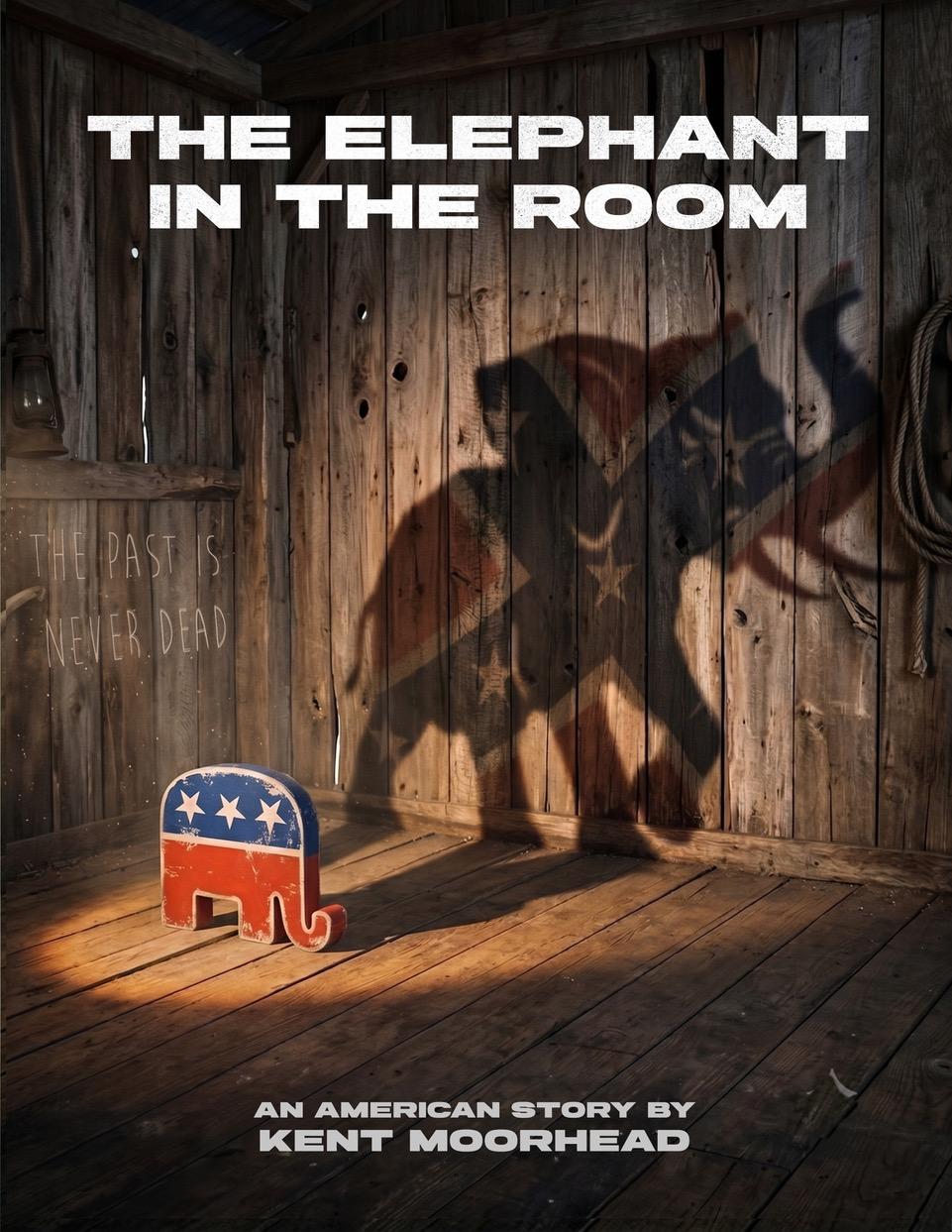
Poster for The Elephant in the Room: an american story - design by John Ennis

The story is about growing up in a troubled time and how a child accepts it as normal while also struggling to understand what is happening. In my case it was about civil rights & the violent reaction against it.This film comes from that personal struggle.
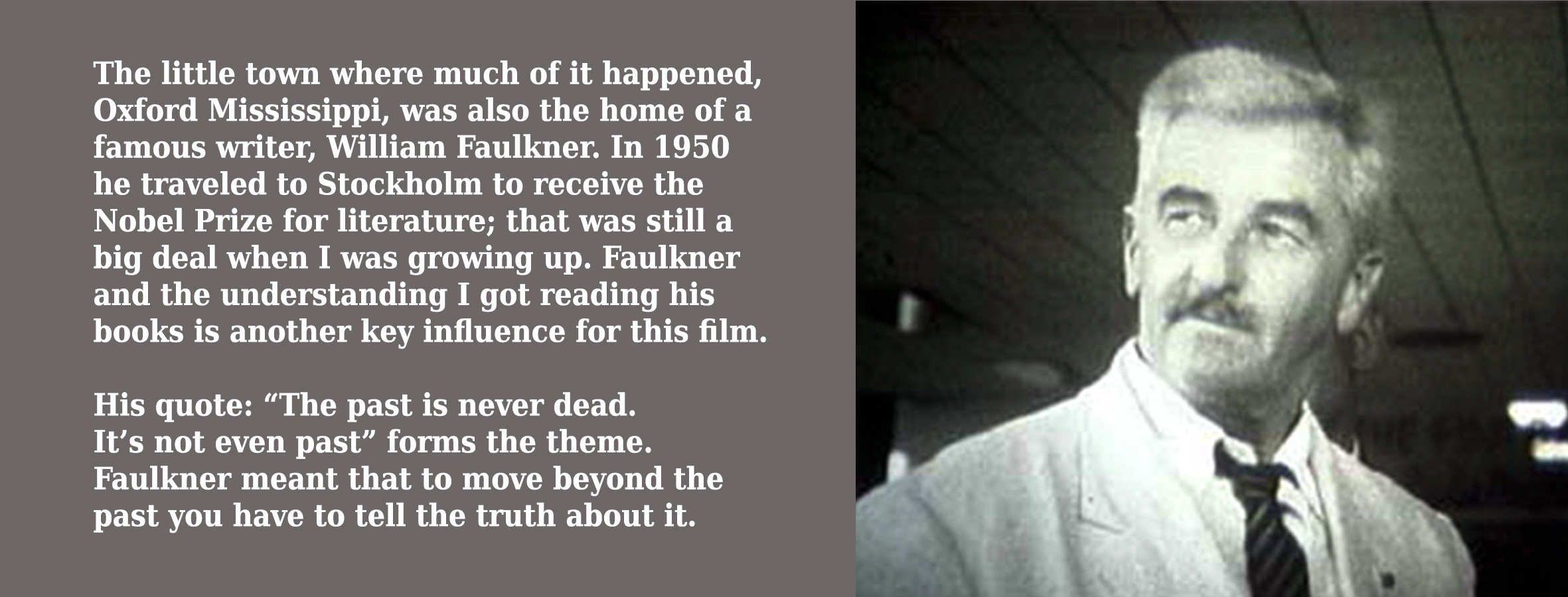
America is in crisis because the past I grew up with didn’t stay in the past, it returned in new forms. The agents of ICE aren't the Ku Klux Klan, which in its day was backed by police and politicians both. But ICE draws from and is sustained by that past.
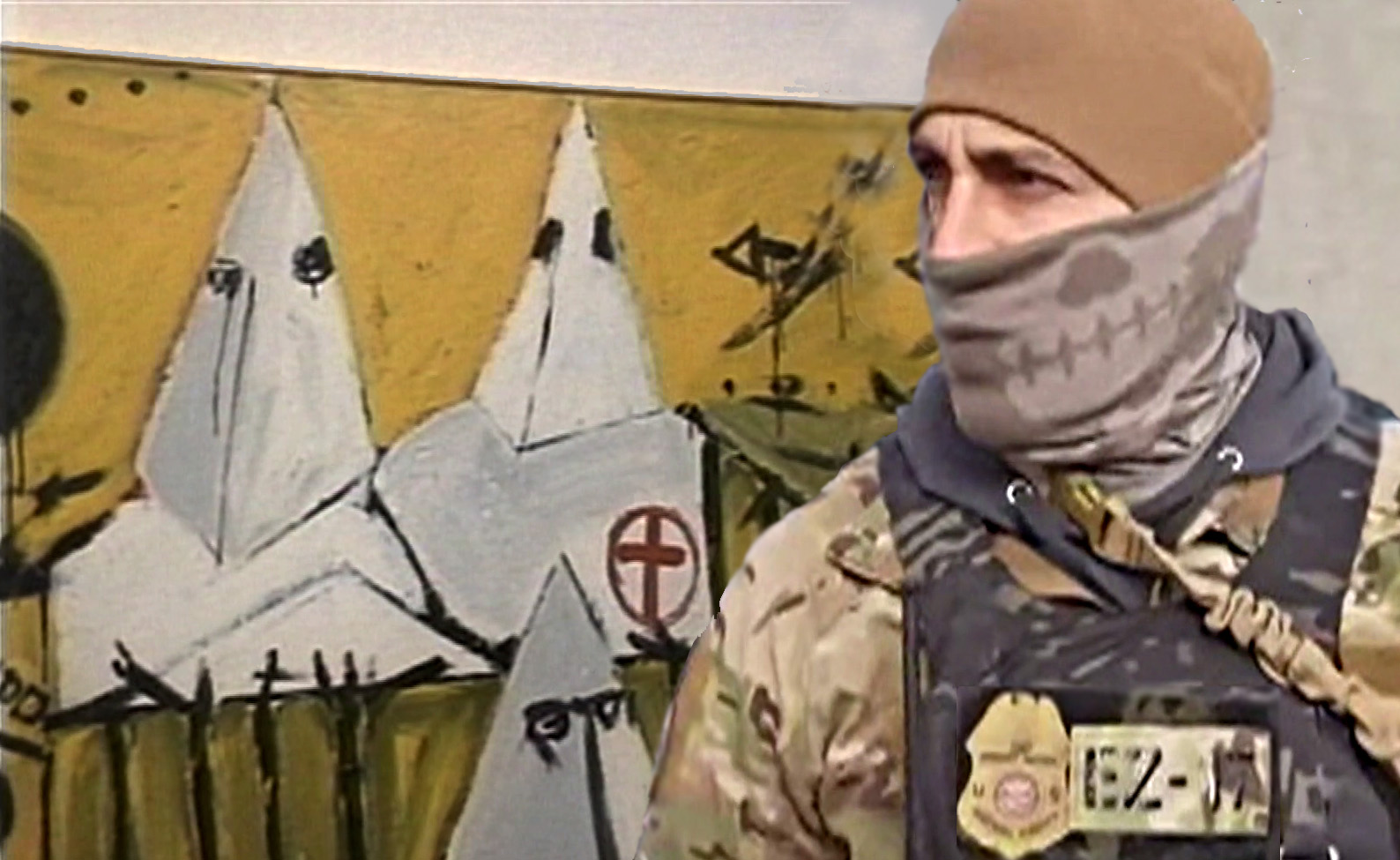
The past is not dead – collage by Kent Moorhead using a William Christenberry painting & film of an ICE agent in a skeleton mask.
A return to the past describes the MAGA movement too, which owes a lot to George Wallace’s 1968 run for President. Wallace was a southern politician fighting against civil rights and he won 13.5% of the country and 46 electoral votes. Half of his voters were outside the south, proving that southern-style racism had national appeal.
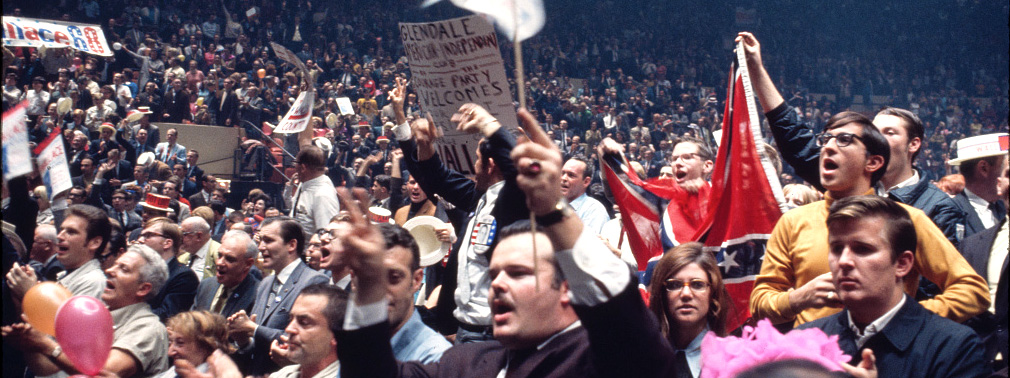
Wallace voters filled Madison Square Garden in New York during his 1968 campaign.
In 1997 I interviewed SNCC activist Victoria Gray Adams to talk about Civil Rights & those who opposed it. SNCC stands for student Nonviolent Coordinating Committee, one of the most important Civil Rights organizations working in Mississippi.
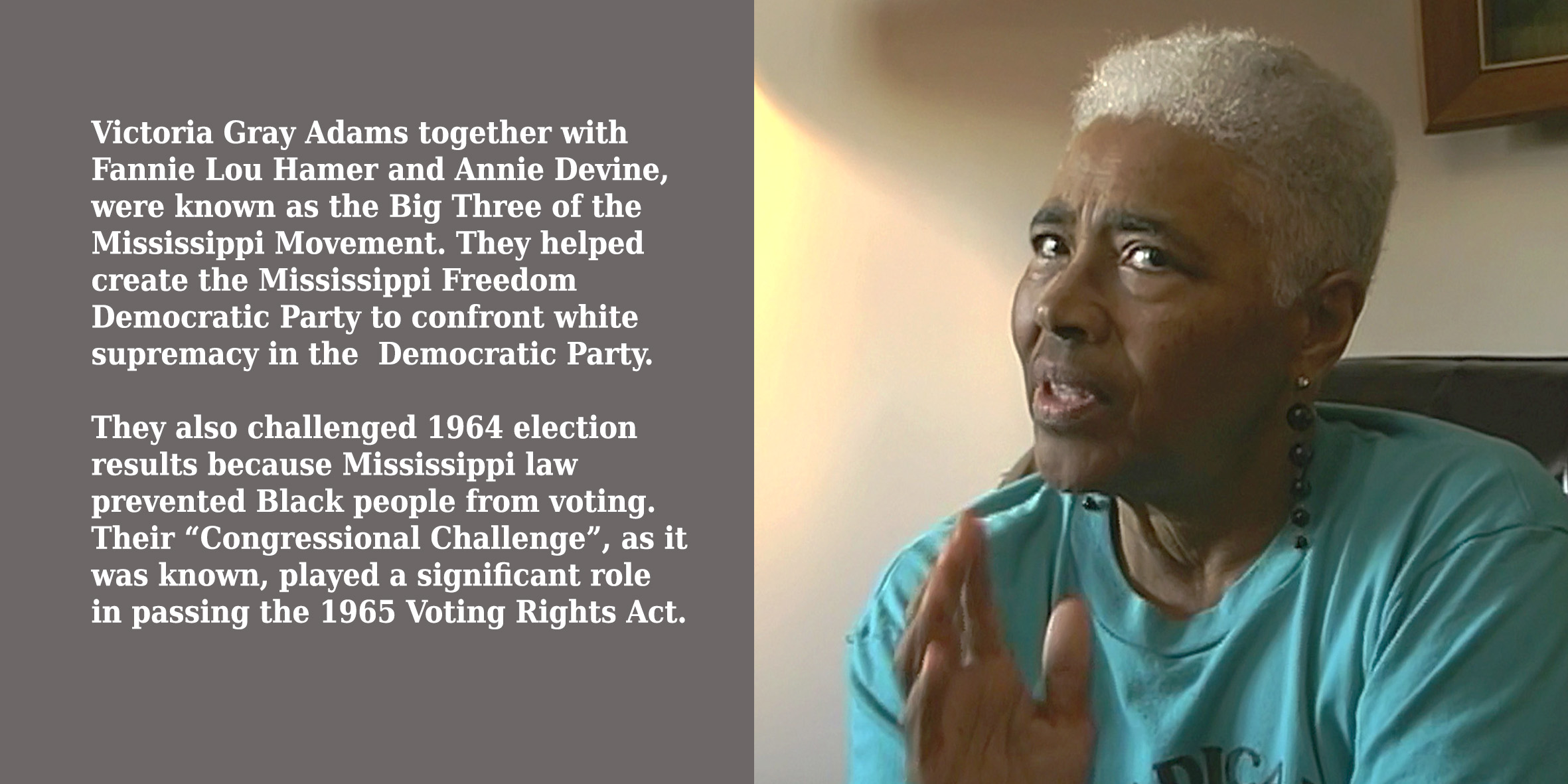
Victoria Gray Adams gave the country responsibility for what happened in Mississippi – and was ahead of her time in saying we had a long way to go. I include her on-camera quote in the film:
"The only reason Mississippi could exist was because the rest of the country permitted it. And so it was no longer a struggle just with Mississippi. It was a national struggle and it still is."

This film confronts our white supremacist past. It pivots on a key historical moment when a Constitutional crisis in Mississippi forced President Kennedy to make a choice, a choice between equal rights or racism.
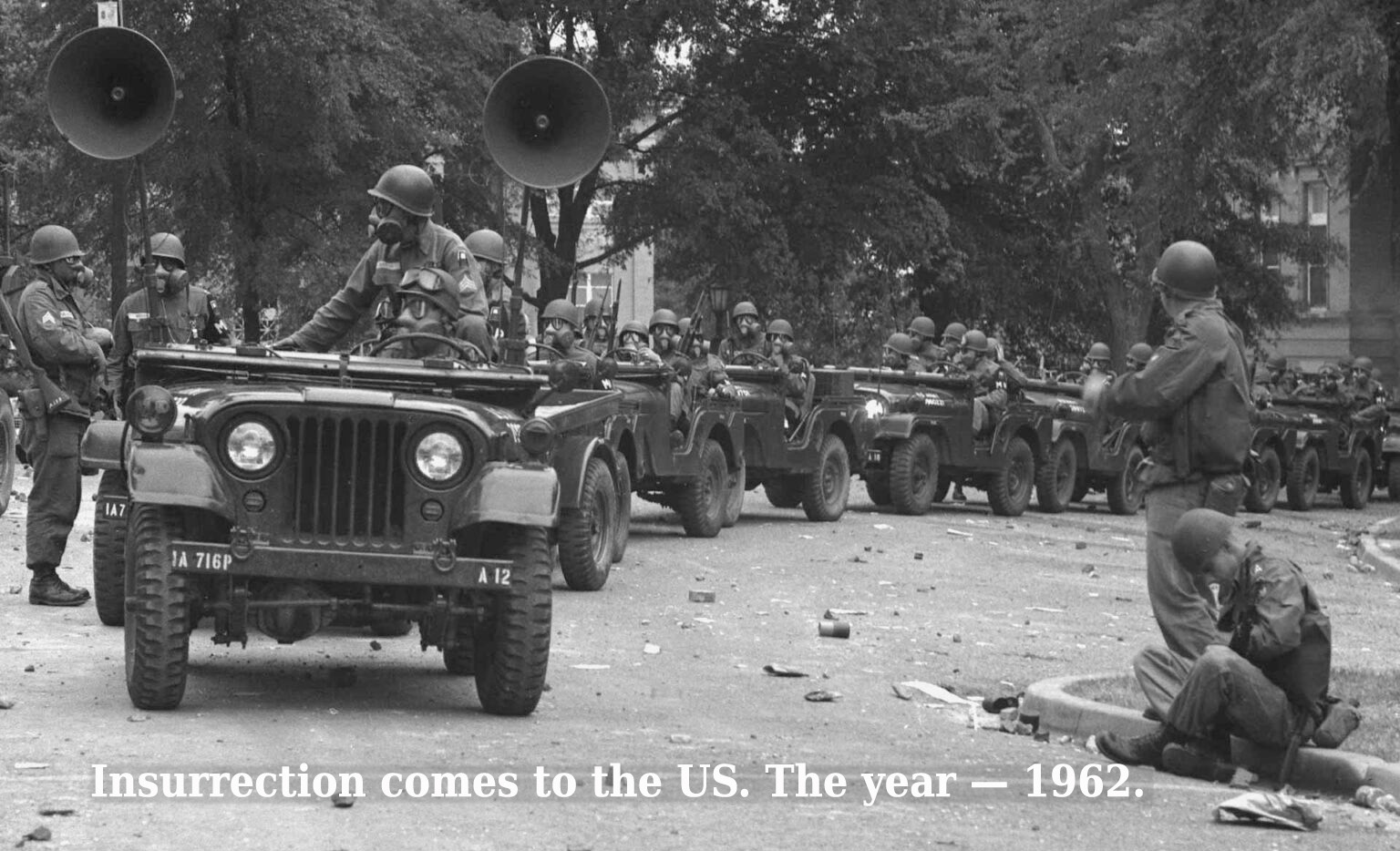 Military Police in Mississippi the morning after the riot/insurrection at Ole Miss. October 1, 1962.
The riot began on a September night. It soon became a full-blown insurrection against the federal government. President Kennedy sent the army’s best to stop it, including the 101st Airborne and the First Army Division, integrated with both black & white soldiers. Over 30,000 troops came to North Mississippi to put down the rebellion. No one talks about it now, almost no one even remembers it.
I think about it all the time. I was an eight-year-old boy who saw it happen. As I explain in my narration to this film:
“It was history raw and first-hand, and I had a front row seat. But I had no one to explain it to me.”
This film is the result of 35 years of filming this story, trying to understand what happened that September night. Learning everything that led up to it, and everything that followed. Trying to understand it so I could explain it.
It happened exactly 100 years after General U.S. Grant occupied/liberated my hometown of Oxford during the Civil War. A war that turned slaves into soldiers, as southern black men fought for freedom in the Union Army. After the war they gained both civil rights and the vote.
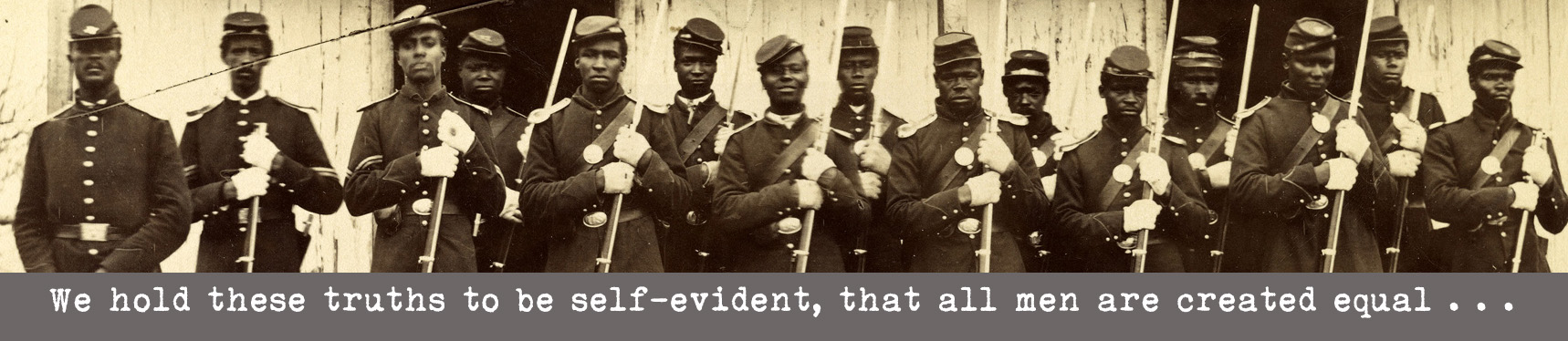
Former Confederates never accepted the equality promised by the Declaration of Independence. When they violently seized power at the end of Reconstruction, they created a new form of oppression based in white supremacy: Jim Crow segregation.
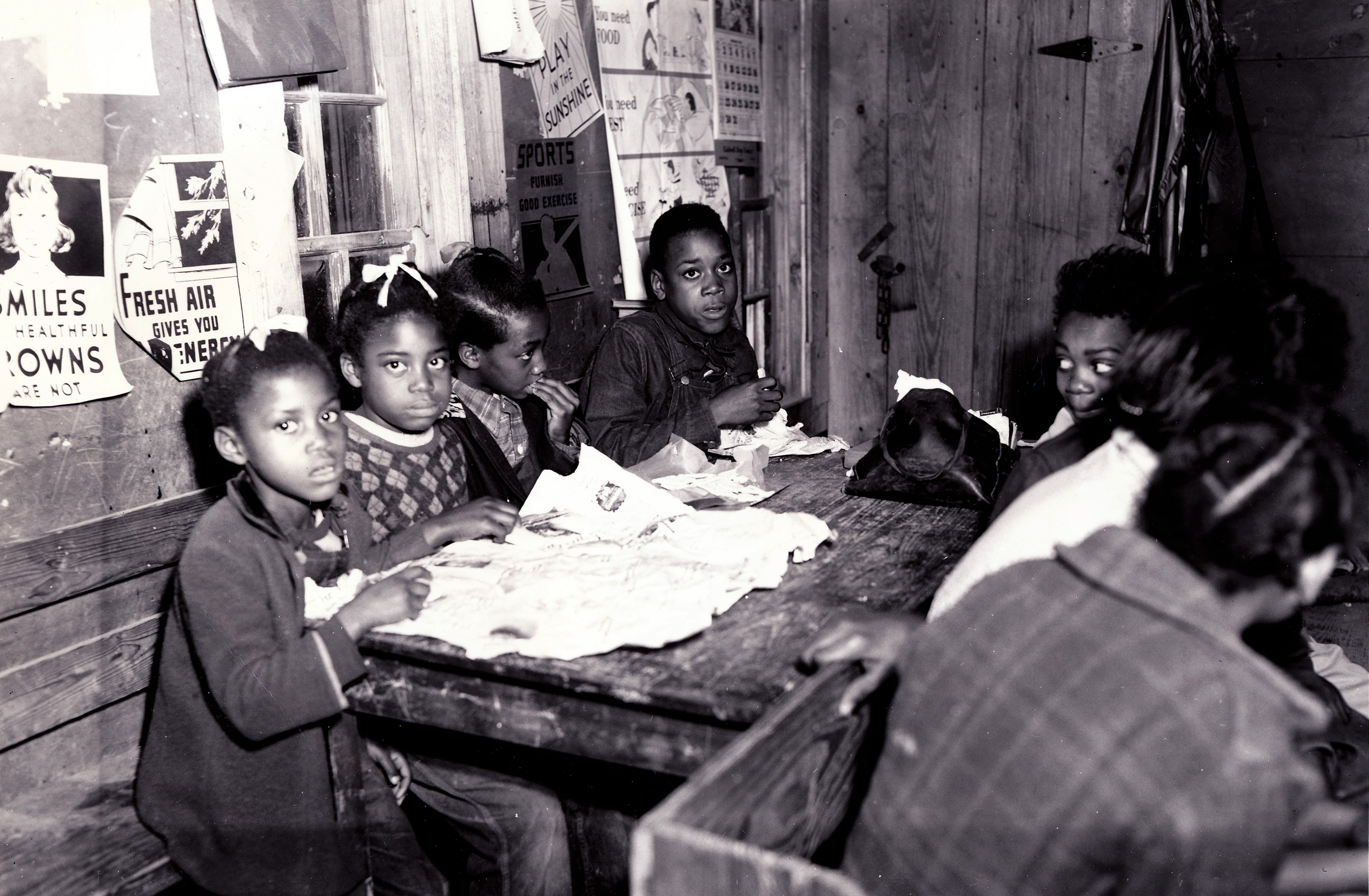
"Separate but Equal" segregation in a 1950s rural Mississippi school for black students. My dad was an educator. This photo from the Phay Collection in the Ole Miss archives was taken by his colleagues at The University of Mississippi as proof that separate meant unequal.
In 1954 the Supreme Court overturned its earlier ruling that legalized segregation, saying that separate schools led to unequal treatment of citizens and was therefore illegal. They ordered the desegregation of public schools.
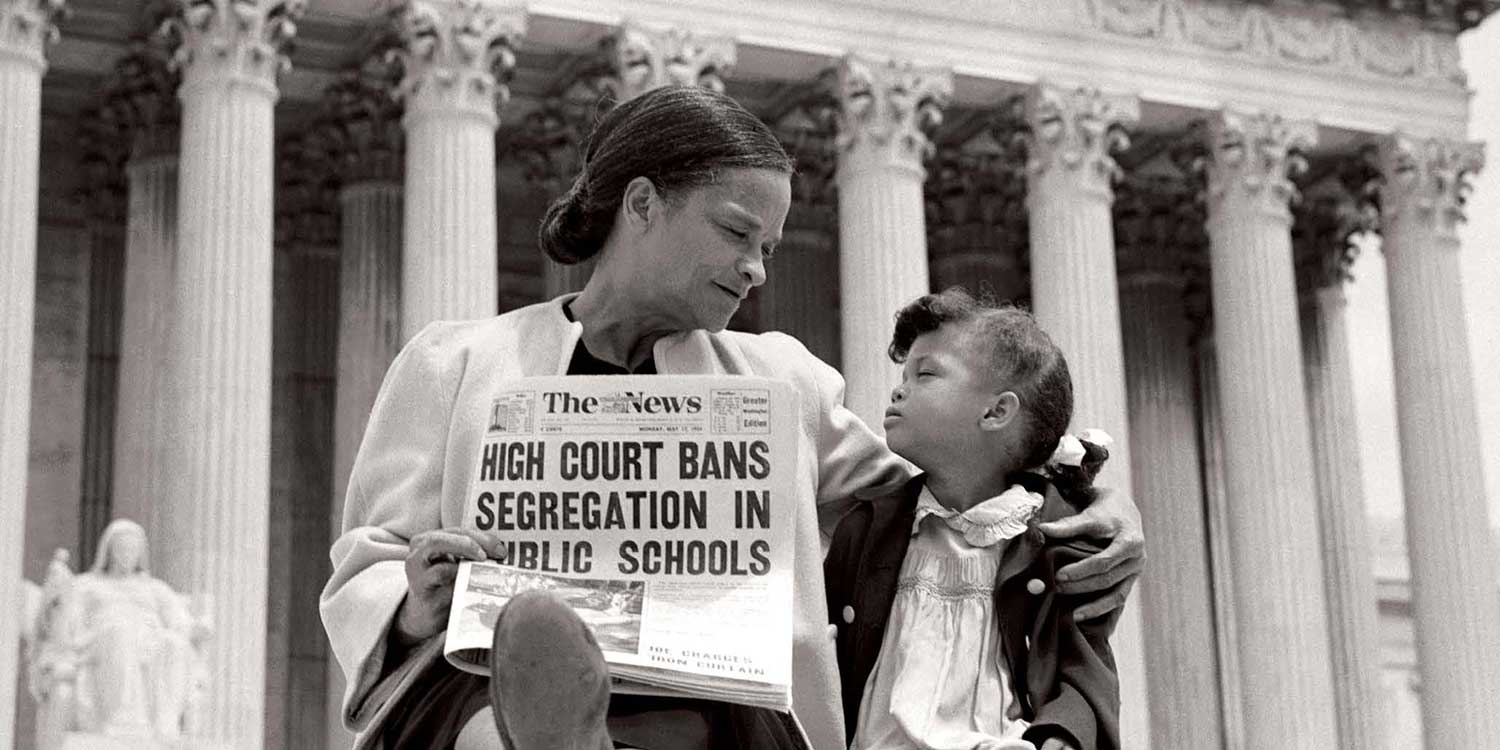
News photograph from Monday, May 17, 1954 after the Supreme Court reversed 58 years of legal apartheid in the United States.
I was born exactly a week after that decision and it shaped my whole life – and creates the story arc of this film. The Court ended segregation but without setting a deadline. Mississippi and Alabama refused to change and up to 1961 nothing happened. Until James Meredith applied to become the first black student at the University of Mississippi, locally known as “Ole Miss”. The Governor said no, claiming Mississippi segregation law “nullified” the Supreme Court ruling. Federal Courts disagreed and ordered that Ole Miss admit Meredith.
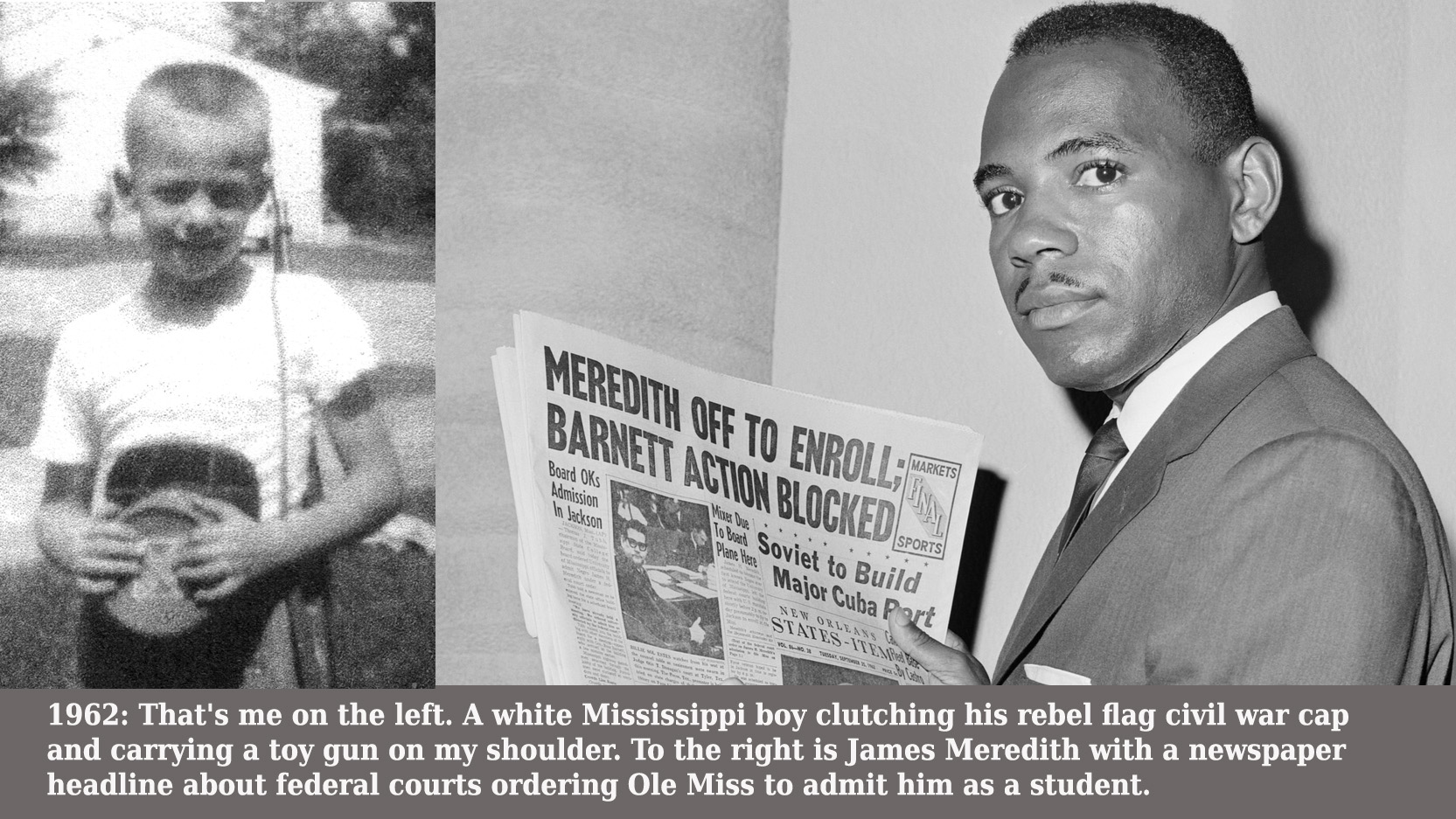
Governor Ross Barnett and Meredith both saw the same thing — that integration of Ole Miss would sooner or later bring about the fall of Jim Crow Segregation in Mississippi and the rest of the south. Which it did.
President Kennedy was looking for a compromise. He wanted to placate Southern racists who were also Democrats and whose votes he needed in the upcoming 1964 election. But there was no middle ground between white supremacy and equality. Kennedy had to choose.
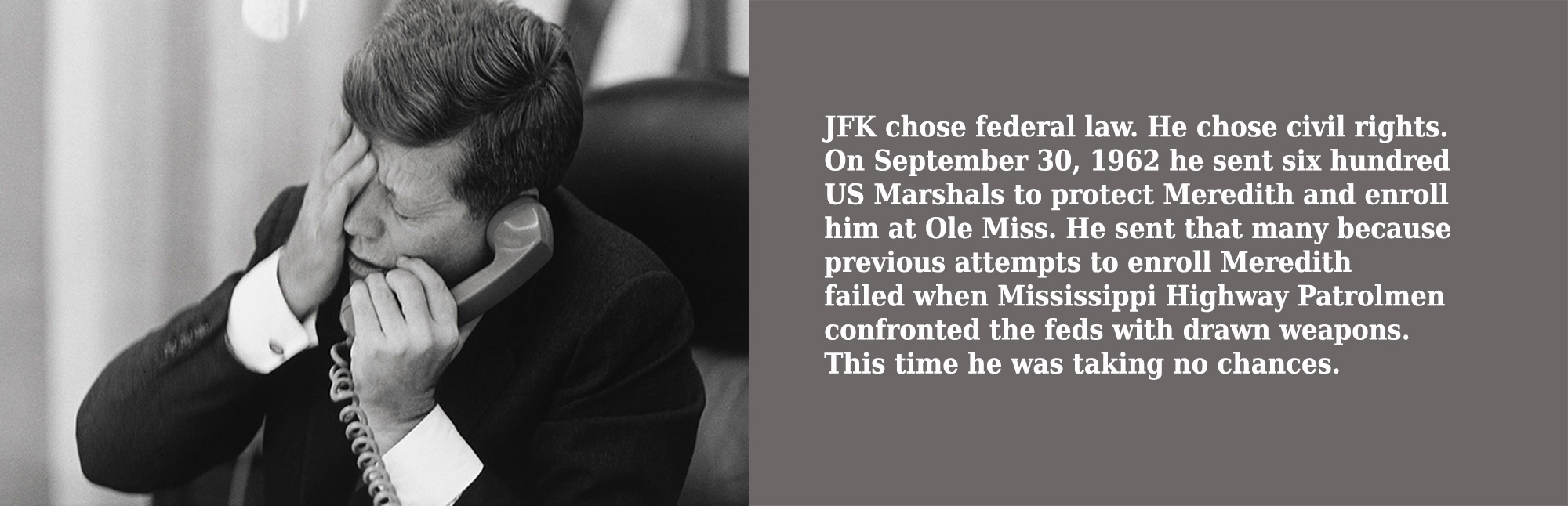 The marshals came with tear gas and riot gear. They wore helmets and had Smith & Wesson revolvers. And orders not to use them.
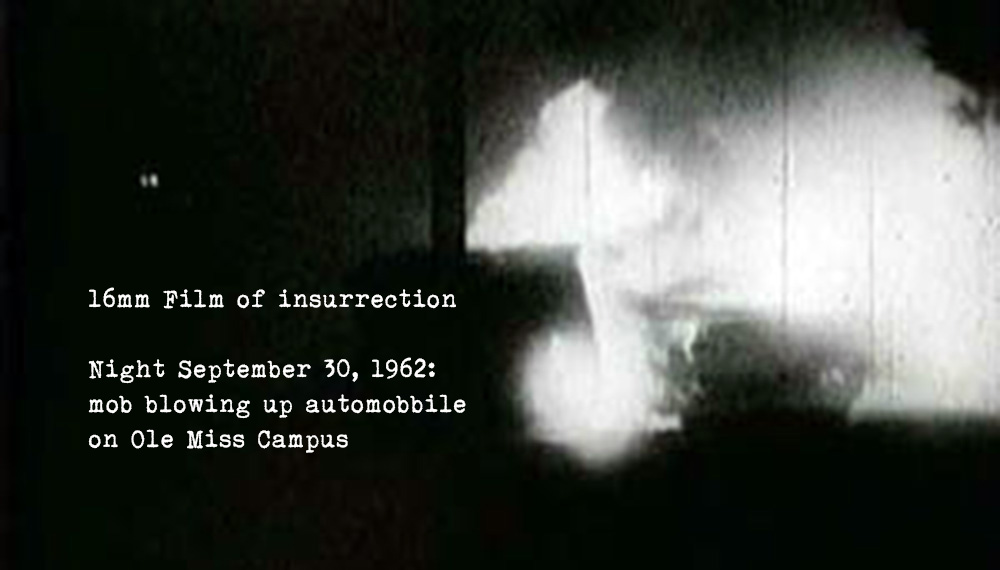 This was no spontaneous riot. it was a planned insurrection with behind-the-scene support and money from the most powerful men in Mississippi and the south.
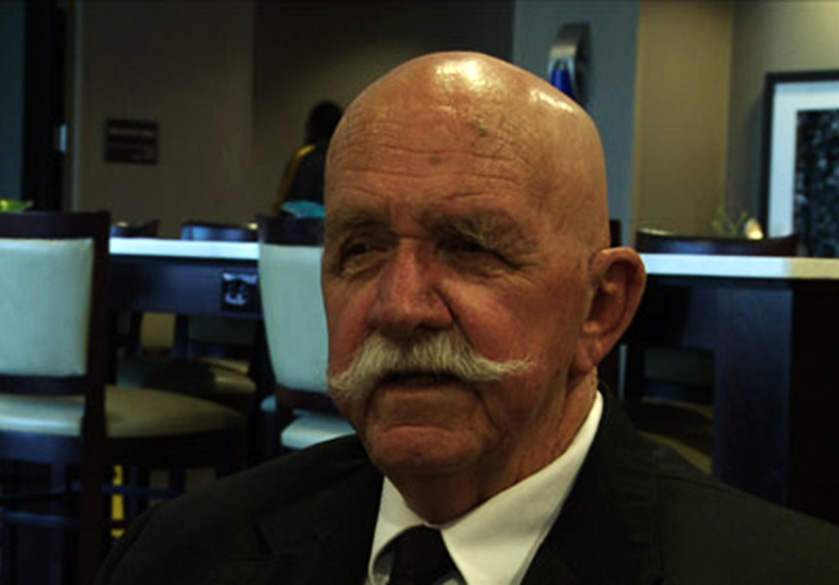 The mob began throwing bricks and concrete cinder blocks. Then bottles of acid. Followed by molotov cocktails. Soon the crack of high powered rifles filled the air as US Marshals were hit with gunfire. William Dunn was a marshal that night. He was on the front lines of the fight, with tear gas as their only weapon to keep the mob at bay. Dunn told me this:
"We had over a hundred men that were wounded by gunfire. When men beside you fall from gunfire, and you don’t return that fire, it takes a helluva man to do that. You don’t realize what would have happened, had we turned those weapons loose. There would have been hundreds if not thousands of casualties".
Kennedy had no choice but to send the army. The alternative was slaughter of the federal men or an explosion of violence throughout the south if they fought back with guns — exactly the bloodshed the insurrectionists wanted. They were hoping to create a revolt that would spread to all the southern states. Dunn’s interview describes his relief as the first troops arrived and the dynamic changed. The film and photographs that survived that night illustrate Dunn’s vivid storytelling – which I mix with my own memories. A time that has haunted me ever since.

What does that long-ago September night in Mississippi say about the January 6th Insurrection?
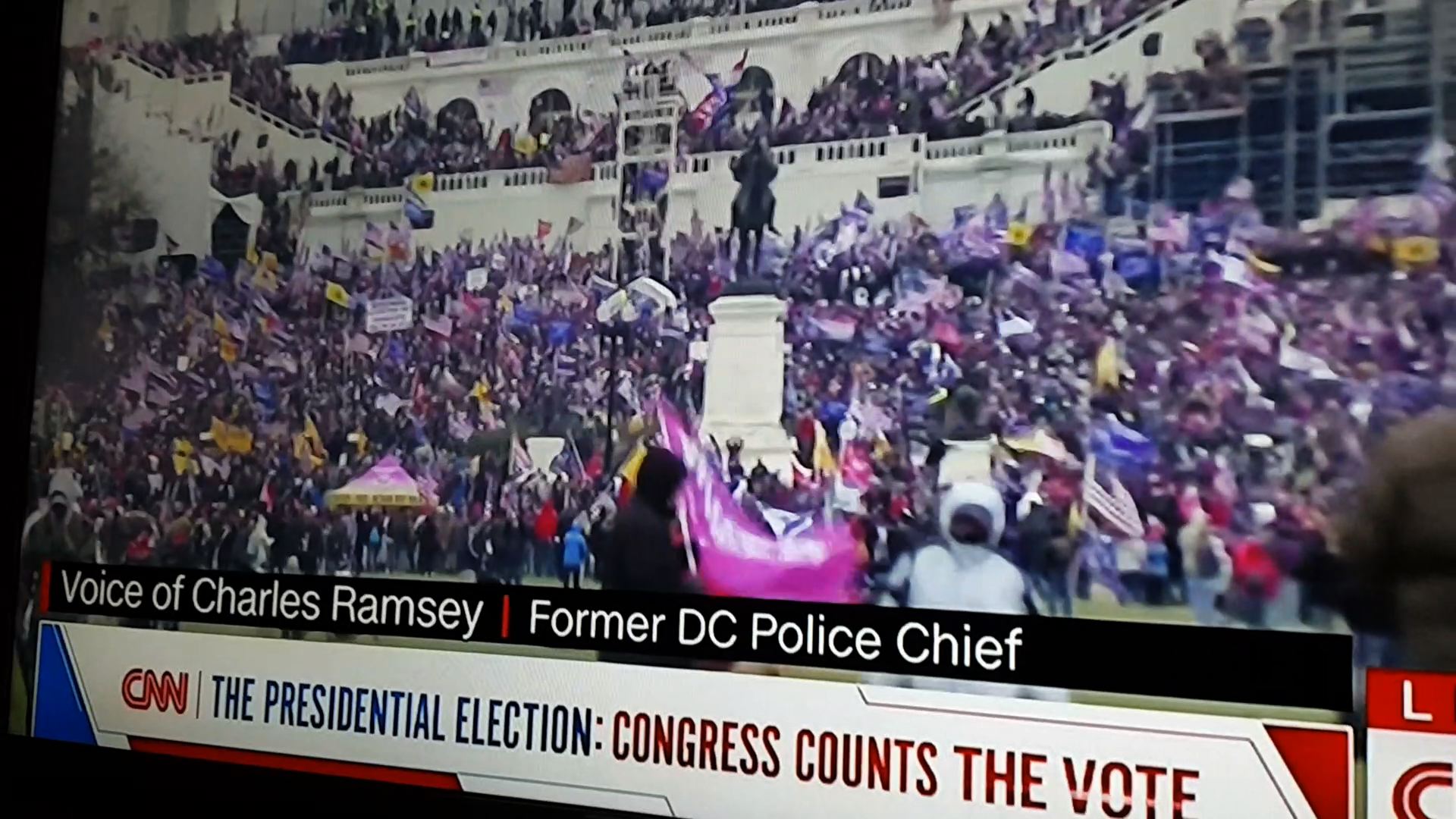 I filmed my TV as CNN described the insurrrection of January 6, 2021. I couldn't believe what I was seeing.
When the Trump mob stormed the US capitol on that January six, the past up and hit me in the face. I was watching CNN from my home in Sweden — which is where I live now. I couldn't believe thousands of men would be so bold, so disrespectful, so anti-democratic as to attack the Capitol, trying to overturn an election. In 1962 it was insurrection against civil rights and our Constitution. What happened on January 6, 2021 was an echo of the same thing. Down to the rebel flags carried by the mob.
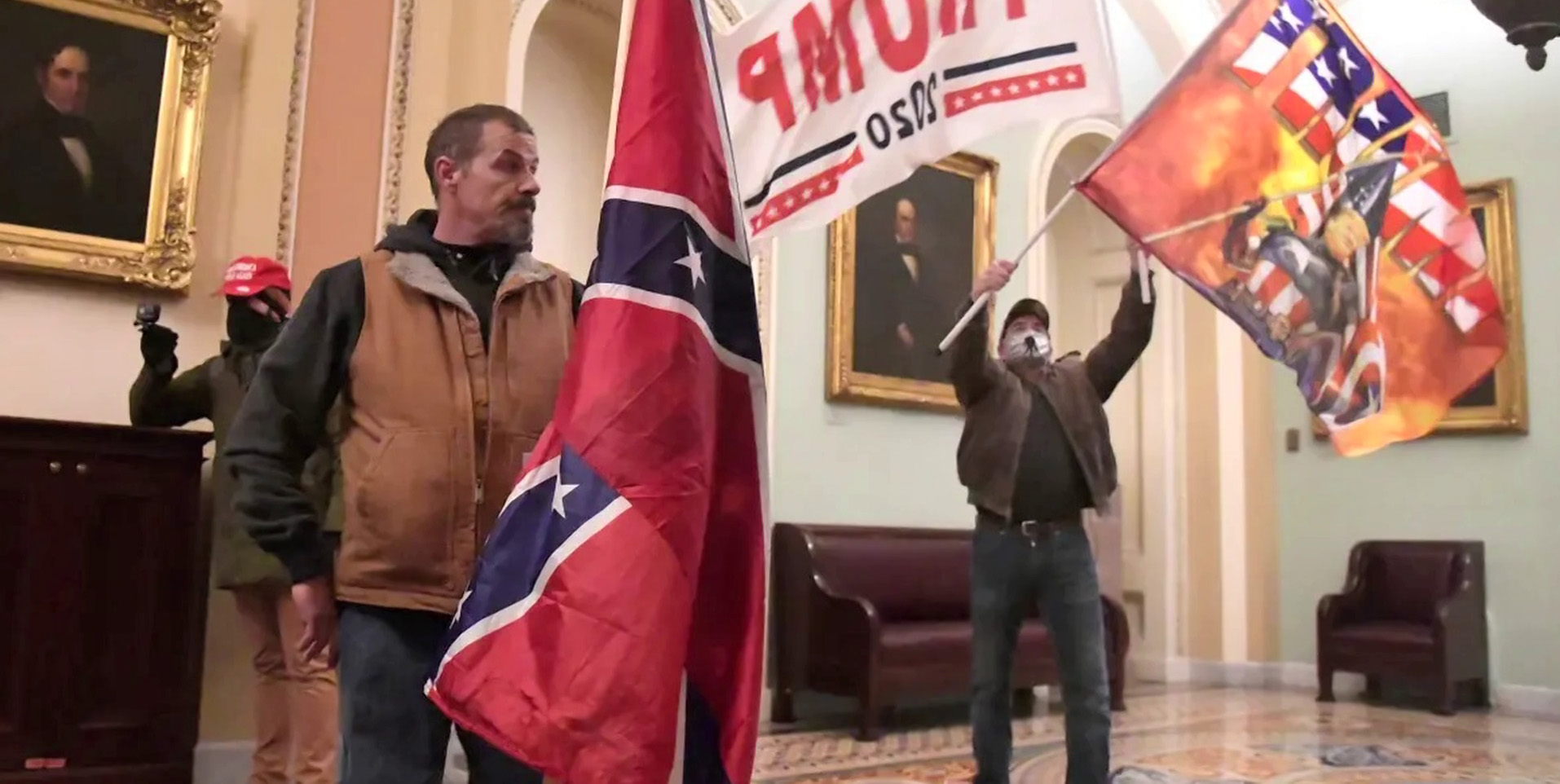
A man in the J6 mob carries a rebel flag into the Capitol - something Confederates never succeeded in doing during the Civil War. Photography by Mike Theiler| Credit: REUTERS
The story of that night at Ole Miss is the pivot point of the film, but it's the years before and the years after that are the main thing, with a focus on how our past created what we face today.

Ole Miss professor James Silver wrote The Closed Society describing how white supremacy controlled everything in Mississippi. He identified the central conflict of 1962 as one between white supremacy and multi-racial democracy. Which is the same battle we face today.
This is a story with the sweep of history behind it. But it's personal, it's told through my eyes as I lived it. It's also a film created over decades, which makes it unique because I didn't stay the same through those years. I changed. You'll see the kind of things I talked about when I started filming in 1990, the questions then. You see my kids too, who I raised in the same place I was born. Except they grew up in an integrated south, attending integrated schools. You also see how I talk in the present day. Because of when I was born and where I grew up, the larger story I tell happens to be the same as my personal story.
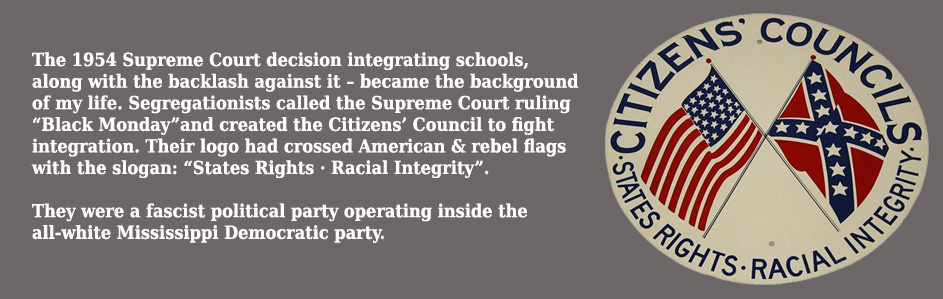
It was MAGA before its time. The Citizens' Councils controlled most media in the state and through that they controlled the politics. They sponsored a radio program that promoted white supremacy and was broadcast nation-wide. Thanks to the Citizens' Councils, Mississippi created its own secret police; it was a new state agency with a strange name — the Sovereignty Commission. Some jokingly called it "the Kudzu KGB". But it was no joke, it was as pervasive and ruthless as the East German Stasi. The film has a personal story of mine about that too.
The film also describes the racial violence in the South including lynching, interpreting that past through my own experience. As I point out in the film, I grew up around men who had blood on their hands. I didn’t know it at the time but they had participated in Oxford’s last lynching in 1936.
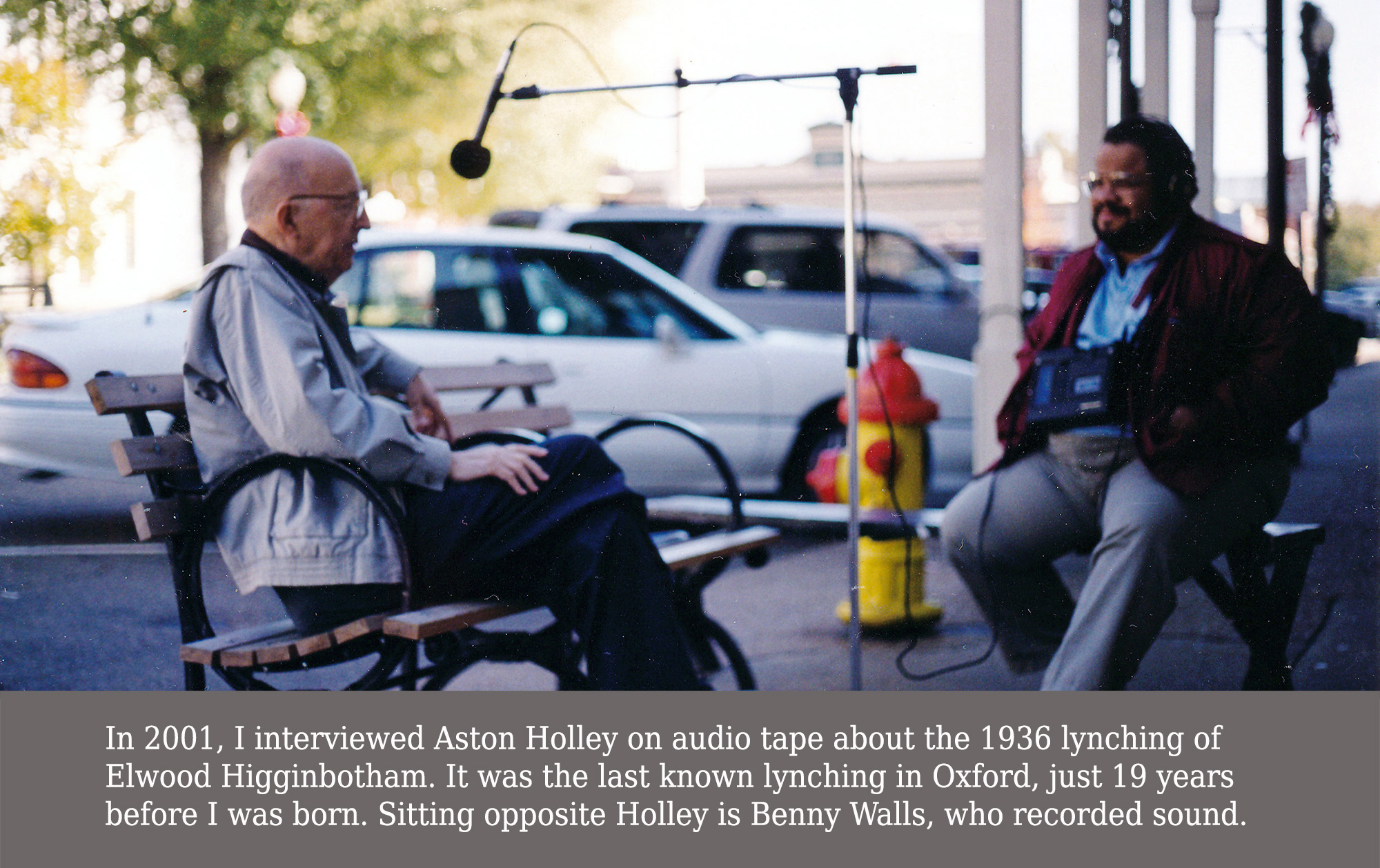
Aston Holley was a boy when the lynching occured and he and his friends watched the lynch mob as it gathered. I learned that some of the men in that lynch mob reprised their real-life role as film extras for the lynching scene in the 1949 Hollywood film, Intruder in the Dust, based on the book by William Faulkner. I can't look at that film anymore without wondering about the men around me when I grew up. Some were actually in the mob. The others stayed silent.

Many people thought the battle over civil rights ended with the 1964 Civil Rights Act and the 1965 Voting Rights Act. But I attended segregated schools right up to 1970. My experience of integration comes toward the end of the film, which was an amazing time. In a very good way.
In the decades that followed, it seemed there really was a new South and a new country. Despite the southern backsliding on race that followed, Barack Obama became the first Black President in 2008. Pundits declared the country to be "post-racial". As it turned out, that was a mirage.
This film explains why. It shows how the white supremacy and racism of George Wallace was the forerunner of Trump's MAGA movement. It helps the viewer see that Donald Trump didn't create MAGA, he just gave it a name.
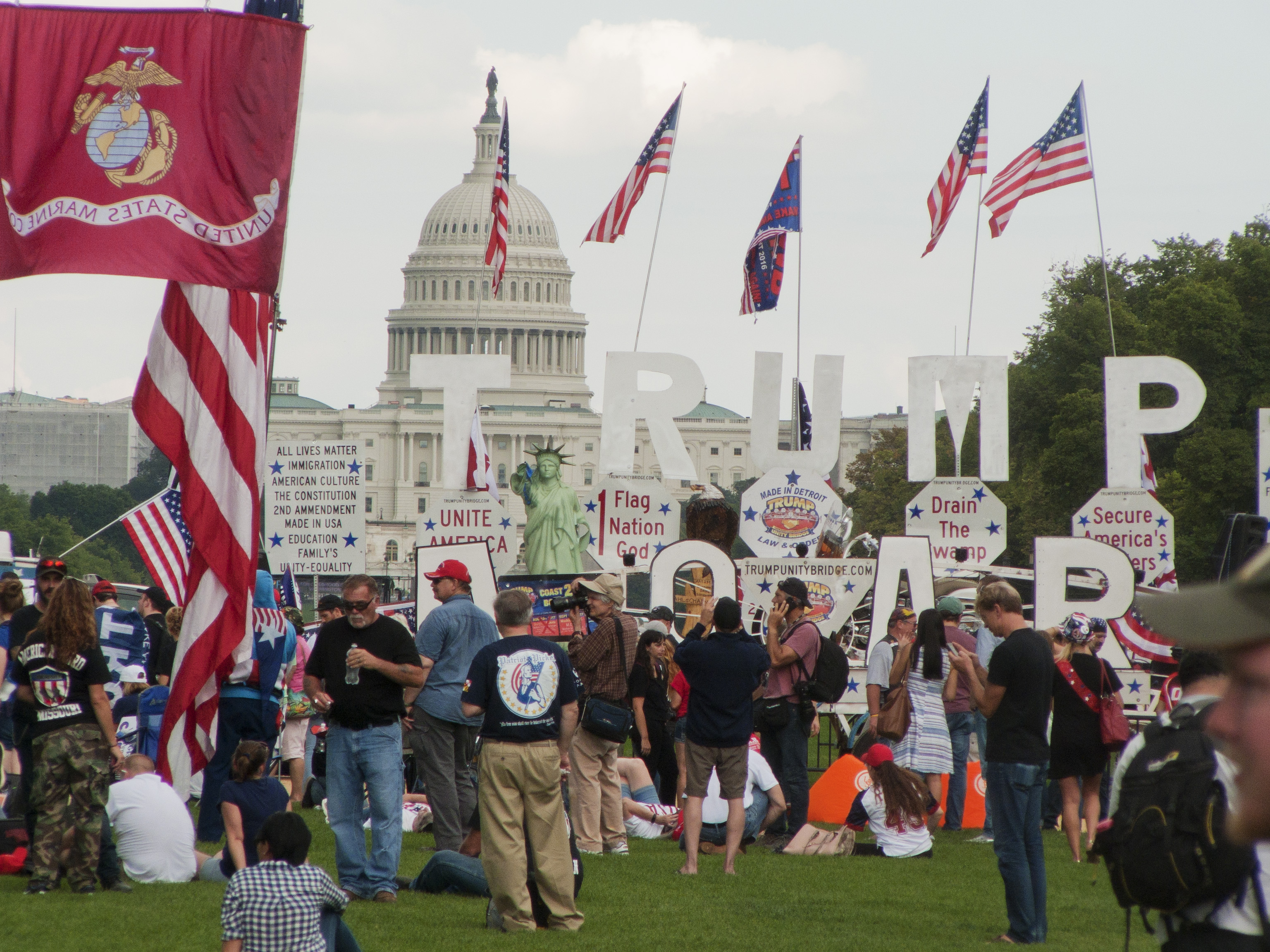 A picture I took at the 2017 MOAR Rally ("Mother of All Rallies") on the National Mall in Washington, in support of Donald Trump.
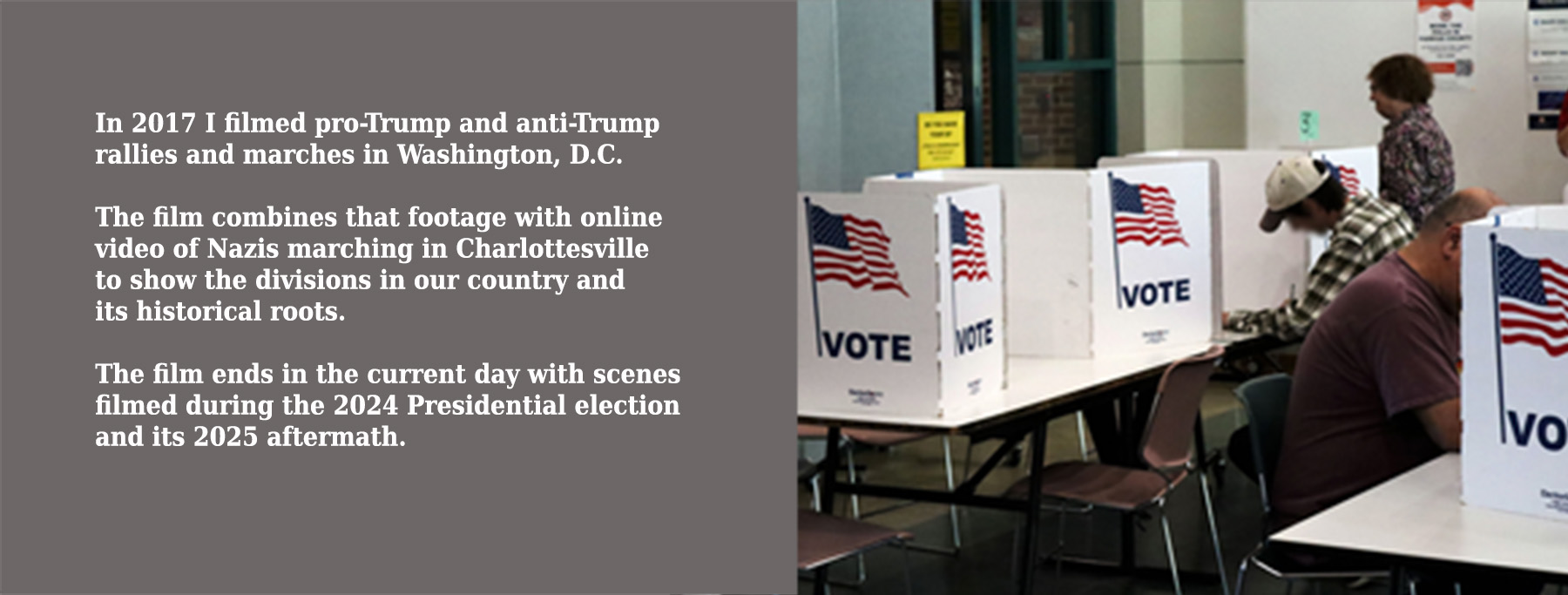
Americans voted to take the US down this path. It's resulted in violent and often illegal deportations; Elon Musk taking a literal & budgetary chain saw to the federal government; and Trump threatening American cities that oppose him. The film relates these things to the white supremacist policies now embedded in MAGA; and it contrasts it to the diversity that actually made America great.
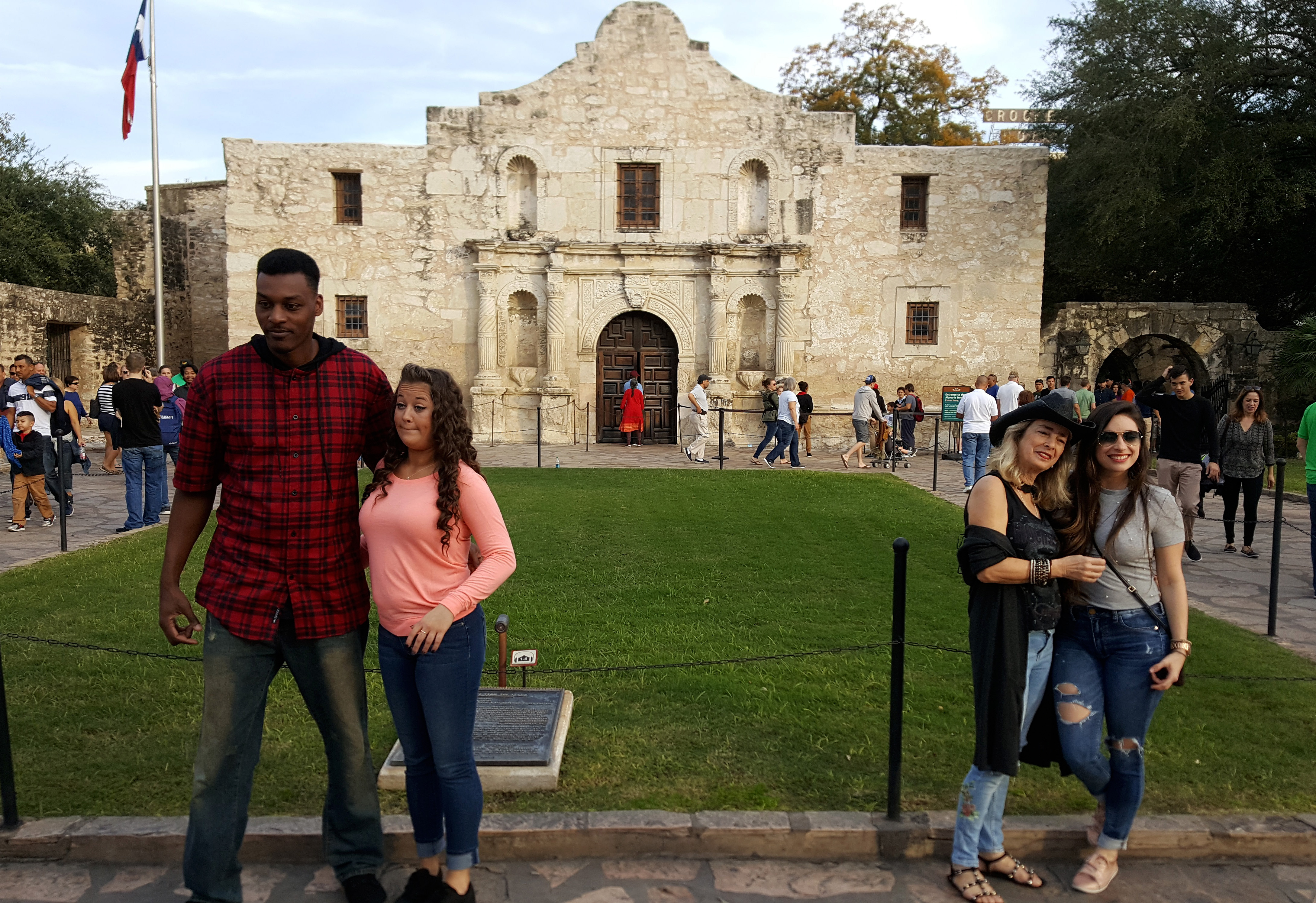
I took this snap on a spring day in San Antonio as tourists posed for photographs in front of the Alamo.

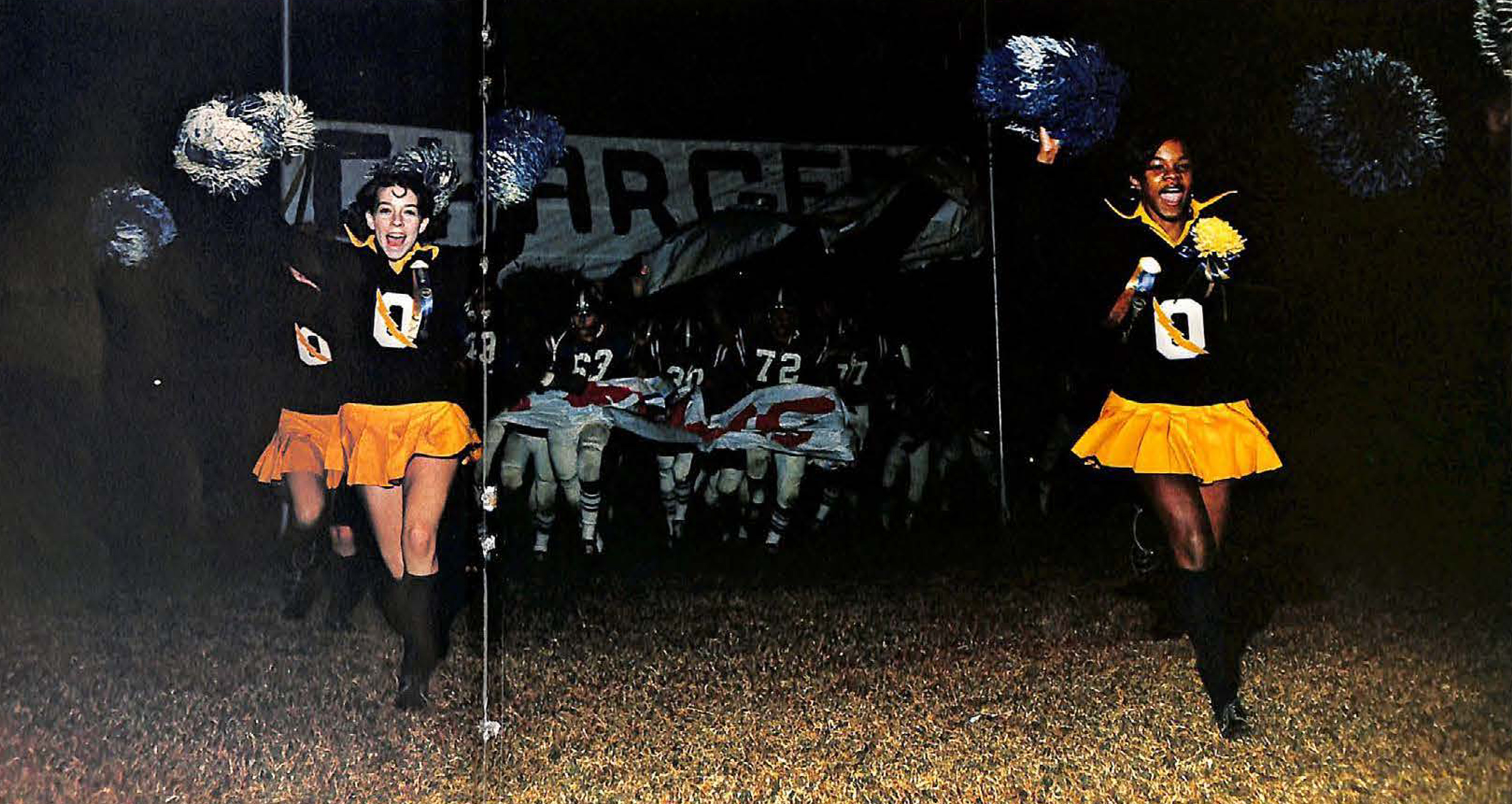
Oxford High School cheerleaders after integration, 1971. This image comes from my High School Annual.
"The past is not not dead, it's not even past" can sound threatening depending on which past it means. But it also points to hope because we aren’t doomed to repeat just any past. We choose the past we keep and pass on to our children.
We change the past too, when we build on what heals and discard what hurts. My story includes that part of our past as well. It tells the story of the integration of my high school, when I joined with a group of black and white students on the student council to fight for the right to meet and interact socially with each other – something our Superintendent of Schools was trying to stop.
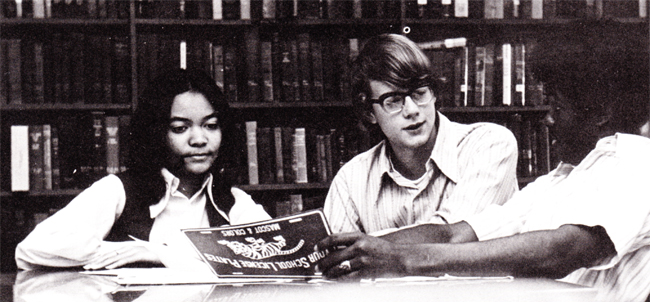
1971. That’s me in a student council meeting at Oxford High School.
The film moves back and forth through time to link past, present and future. The legacy of Abraham Lincoln is both past history and something still with us today.
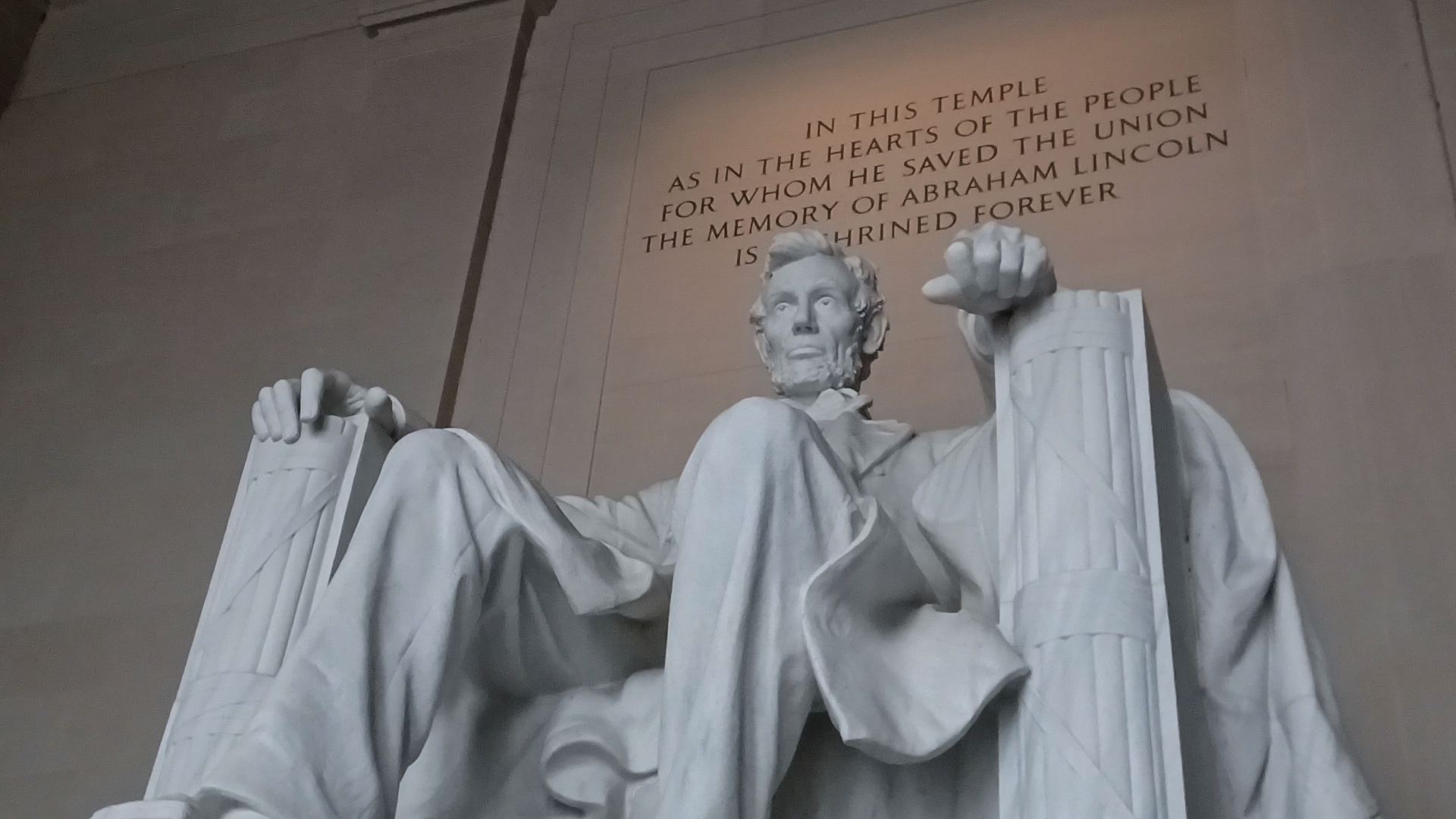
Lincoln talked of “a new nation, conceived in Liberty, and dedicated to the proposition that all men are created equal.” During his Gettysburg Address he said:
“Now we are engaged in a great civil war, testing whether that nation, or any nation so conceived and so dedicated, can long endure.”
Our testing didn’t end with the Civil War. It’s with us, still forcing us to choose what kind of nation we want to be.

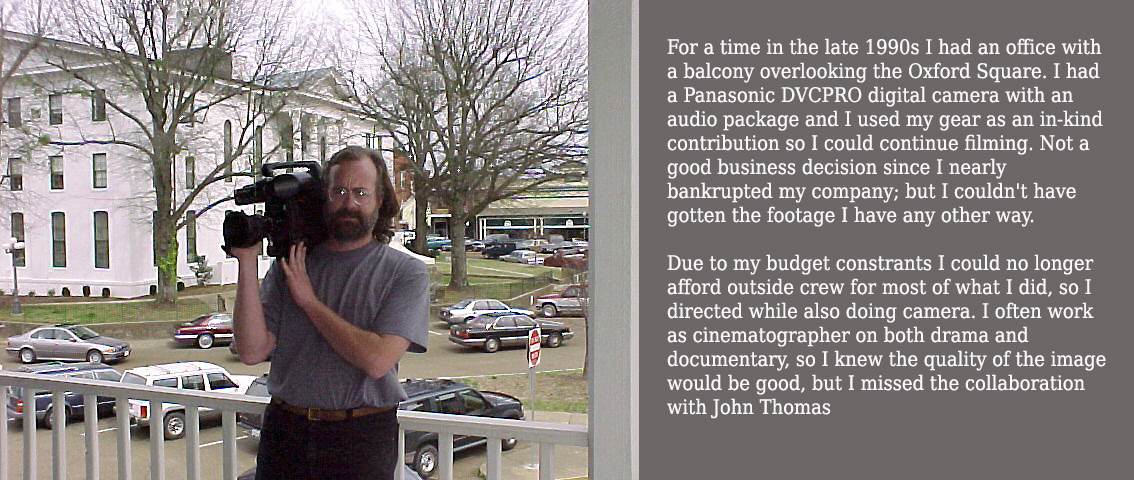
I've been at this a long time. The first 16mm film rolled through my camera in November of 1990. Thirty-five years ago. I had grants from the arts group Appalshop in Kentucky and the South Carolina Arts Commission and was able to begin filming with an experienced crew. I met my cameraman John Thomas, when I was a student at NYU Grad Film in the late 1970s. During planning, John and I decided that I would appear on-camera as a character in the film, which set the style I would continue throughout the making of the film.
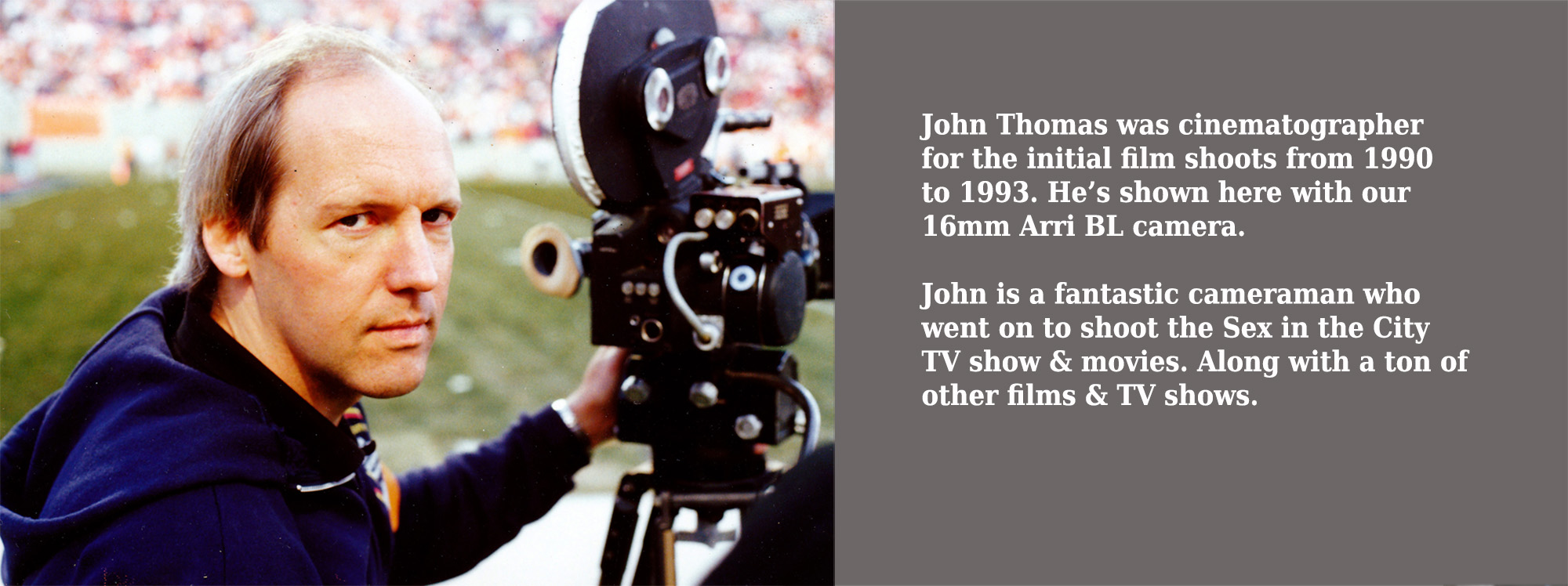
From 1990 to 1993 I filmed in Oxford, Mississippi; Jackson, Mississippi; Memphis, Tennessee, Shiloh Battlefield; and Washington, D.C.
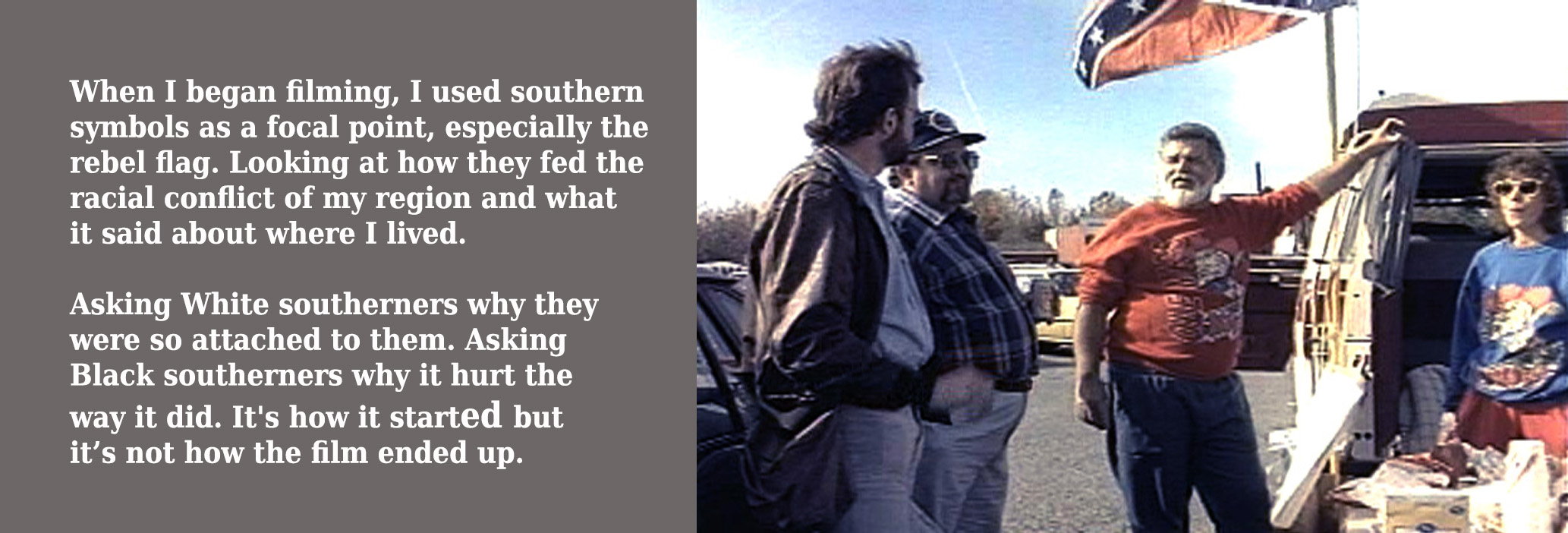
Brit Warner did sound on those shoots. Brit’s an excellent sound mixer who’s worked extensively in TV and film out of Atlanta. When I have the budget for it I use double-system sound recording, which gives you both high-quality sound and full freedom of movement for the camera.
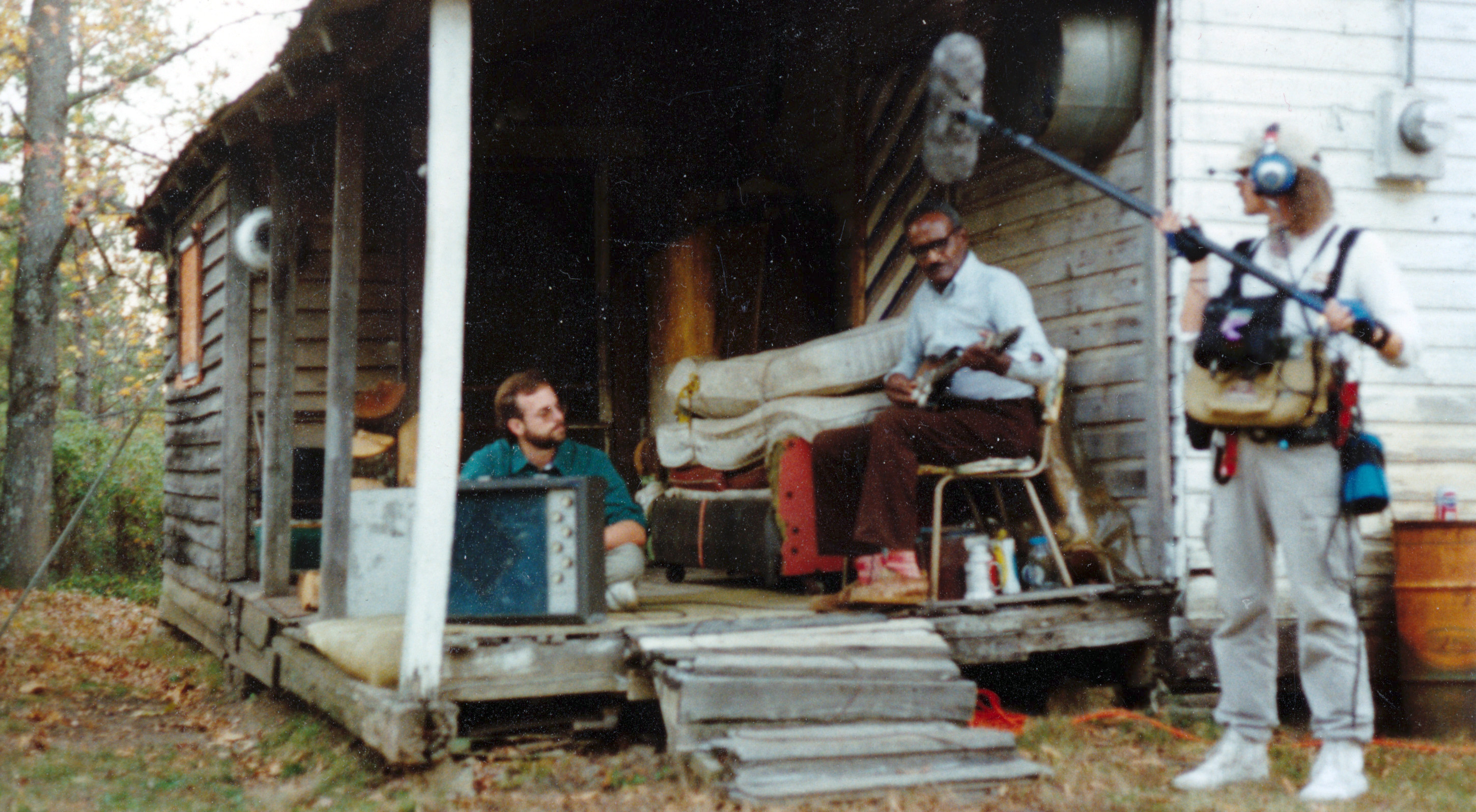
The image below is Brit recording sound as I listen to a man named Mr. Godwin playing blues on his back porch.
In 1994 I showed the first edit of this film at the Independent Film Market in New York. It was a 30 minute work-in-progess with the title: Robert E. Lee May Have Surrendered But I didn’t: A Short History of the Rebel Flag. My film was about the underlying issues of race, white supremacy and the history behind it all, especially slavery and Jim Crow segregation
The audience seemed interested. Buyers weren’t.
In the mid-90s I ran out of money. The flag had become a toxic subject and I could no longer get grants to continue the film. I began to self-finance through my film company, Passage Film, Inc.
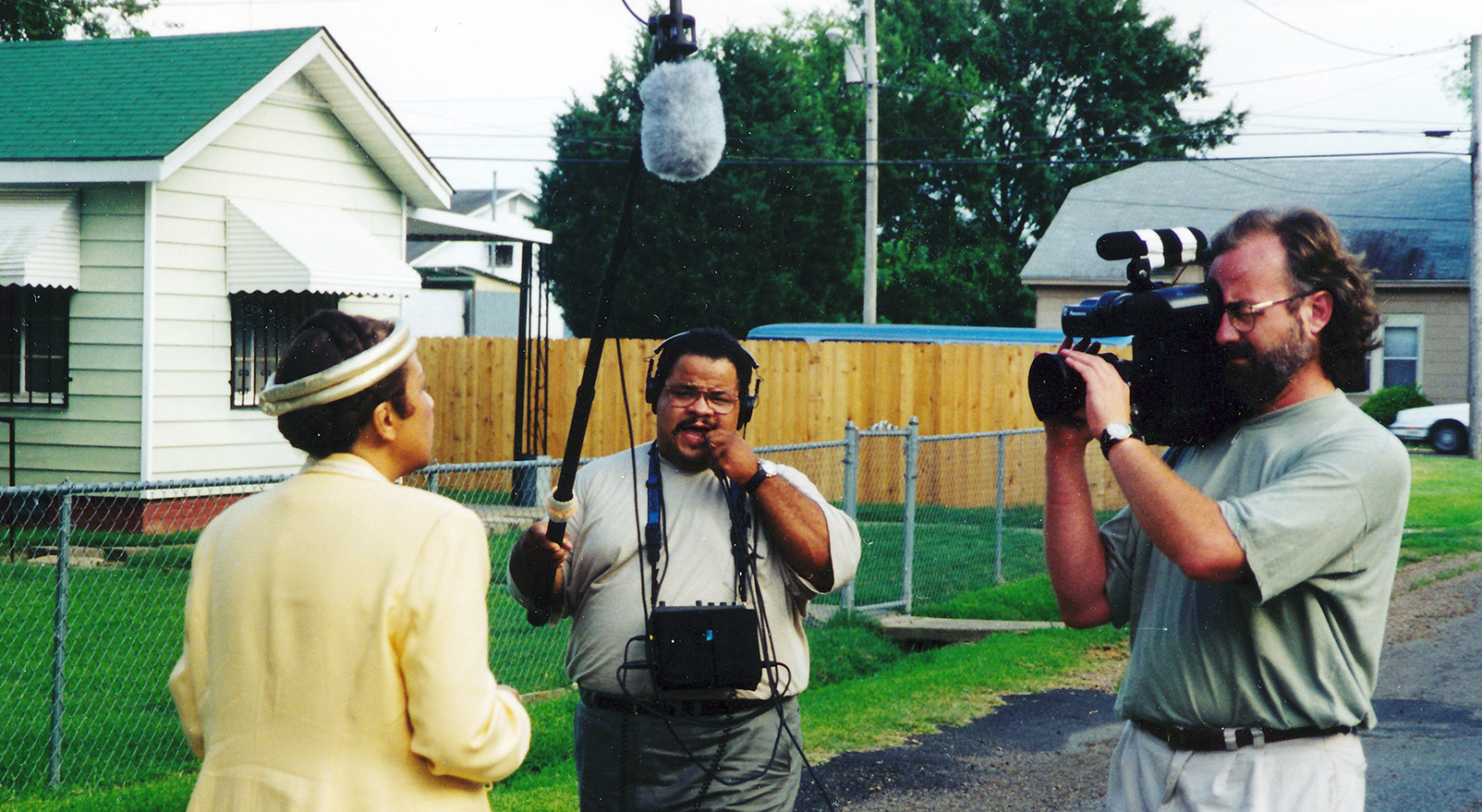
Sometimes I had to record sound myself as well. When I had money – as I did for many of the Civil Rights interviews – I used a very good Oxford soundman, Bennie Walls, That's Bennie in the image below, recording sound as I interviewed Civil Rights activist Flonzie Brown-Wright in Canton, Mississippi.
This film draws from the filming I did about the rebel flag; as well as additional work about the Mississippi Civil Rights Movement. Plus extensive filming of James Meredith and the Ole Miss insurrection of 1962, films about African-American in the Civil War and World War II, plus my filming of race relations in Mississippi. I also have an extensive collection of family photographs and 8mm film as well as my own still photography – all of which I use in telling this story.
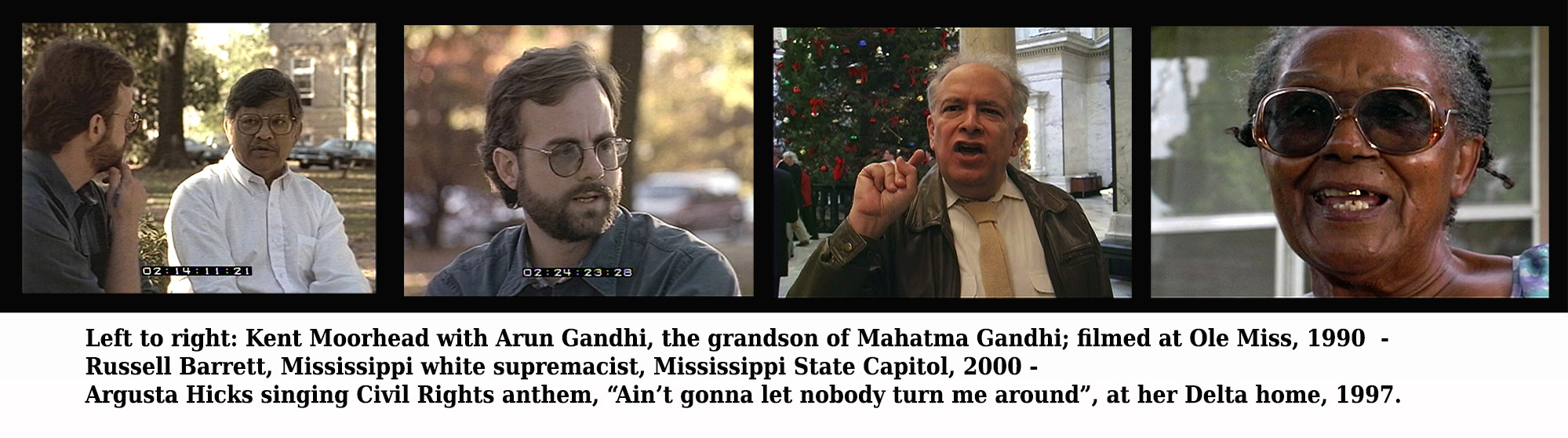
What I discovered in filming over three decades was that I covered the beginning of a political movement. In the 1990s it was about hanging on to the symbols of the past, but more than that. Hanging onto those attitudes as well.
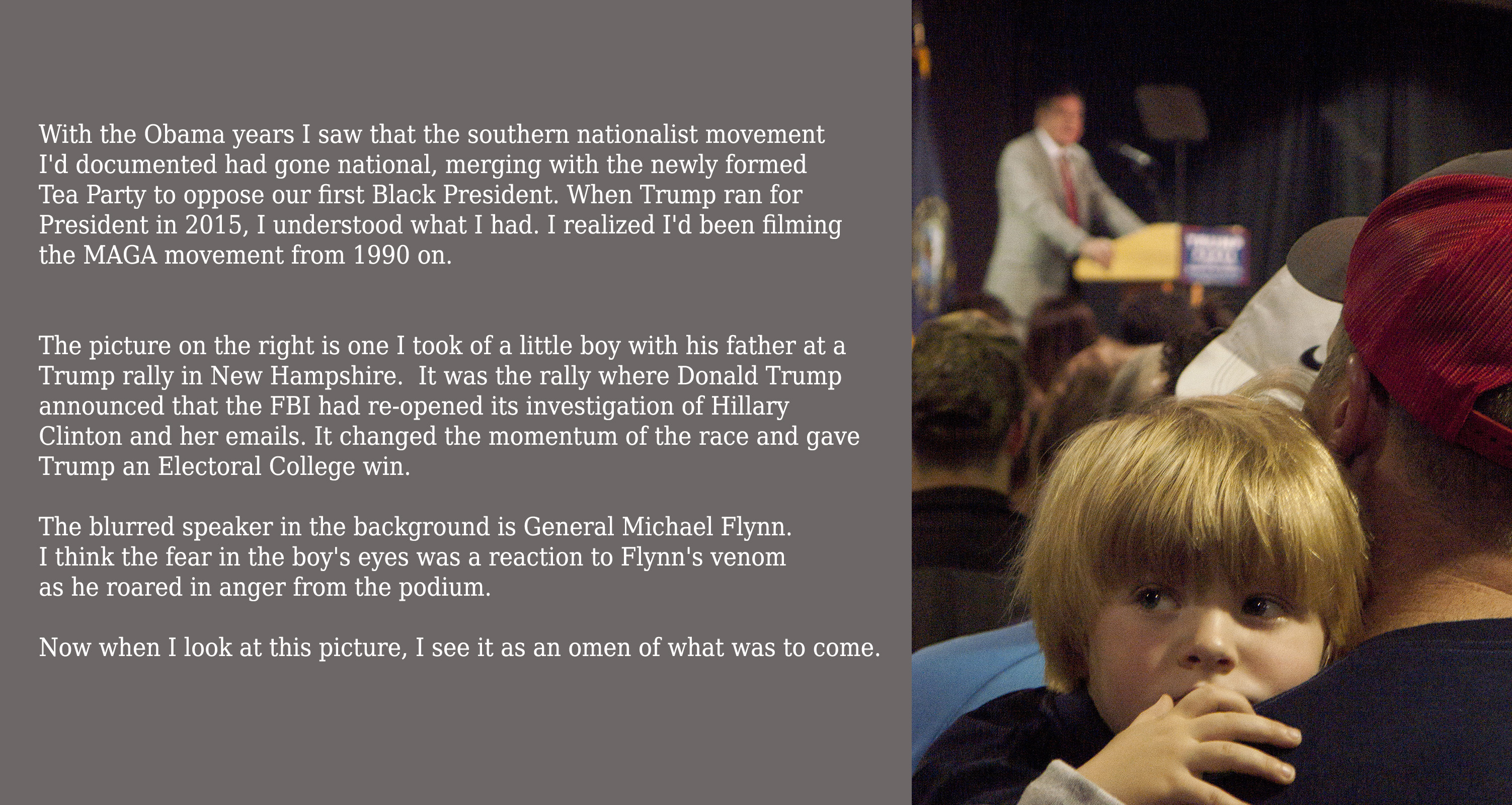
America is in a long-running conflict over multicultural democracy and it’s reflected in my own story.
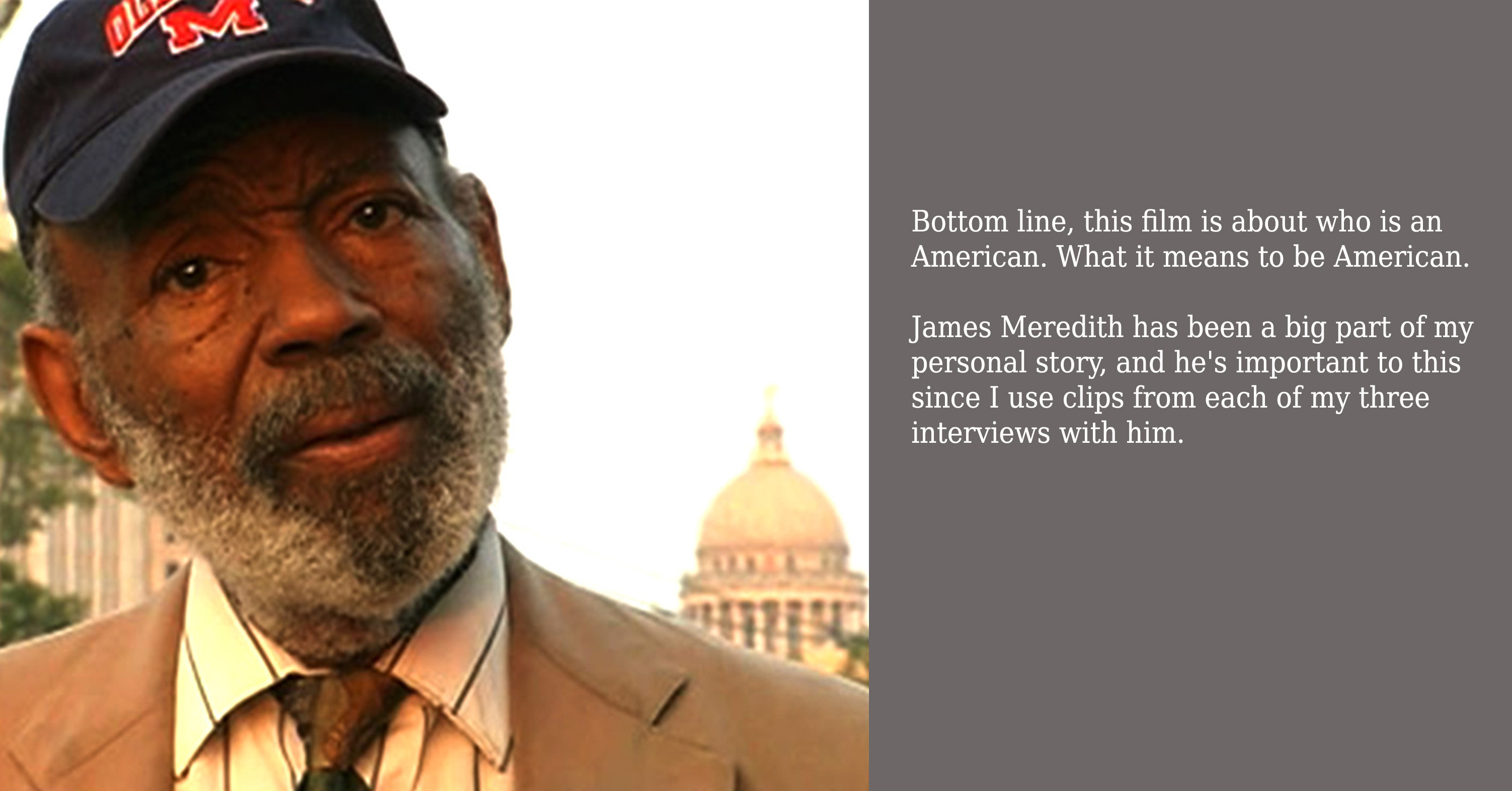
As James Meredith puts it in his 2005 interview:
". . . its about citizenship and the rights and privileges of citizenship
and who’s going to enjoy them. And my goal has always been 100%."

The Signficance of the film
People in America and around the world see the USAs rapid plunge into fascism after Donald Trump’s return to the Presidency and can’t believe it’s real: how did the U.S. get here so fast? The Elephant in the Room: an american story shows that the US always had a version of fascism in its politics, starting with slavery and continuing with the Jim Crow era of segregation. Few know, for instance, that the Nazi anti-Jewish Nuremburg Laws were inspired by the segregation law of Mississippi and other Southern US states. It wasn't just Nazis that looked south for inspiration. Films like Birth of a Nation, Gone with the Wind & Disney's Song of the South celebrated southern white supremacy.
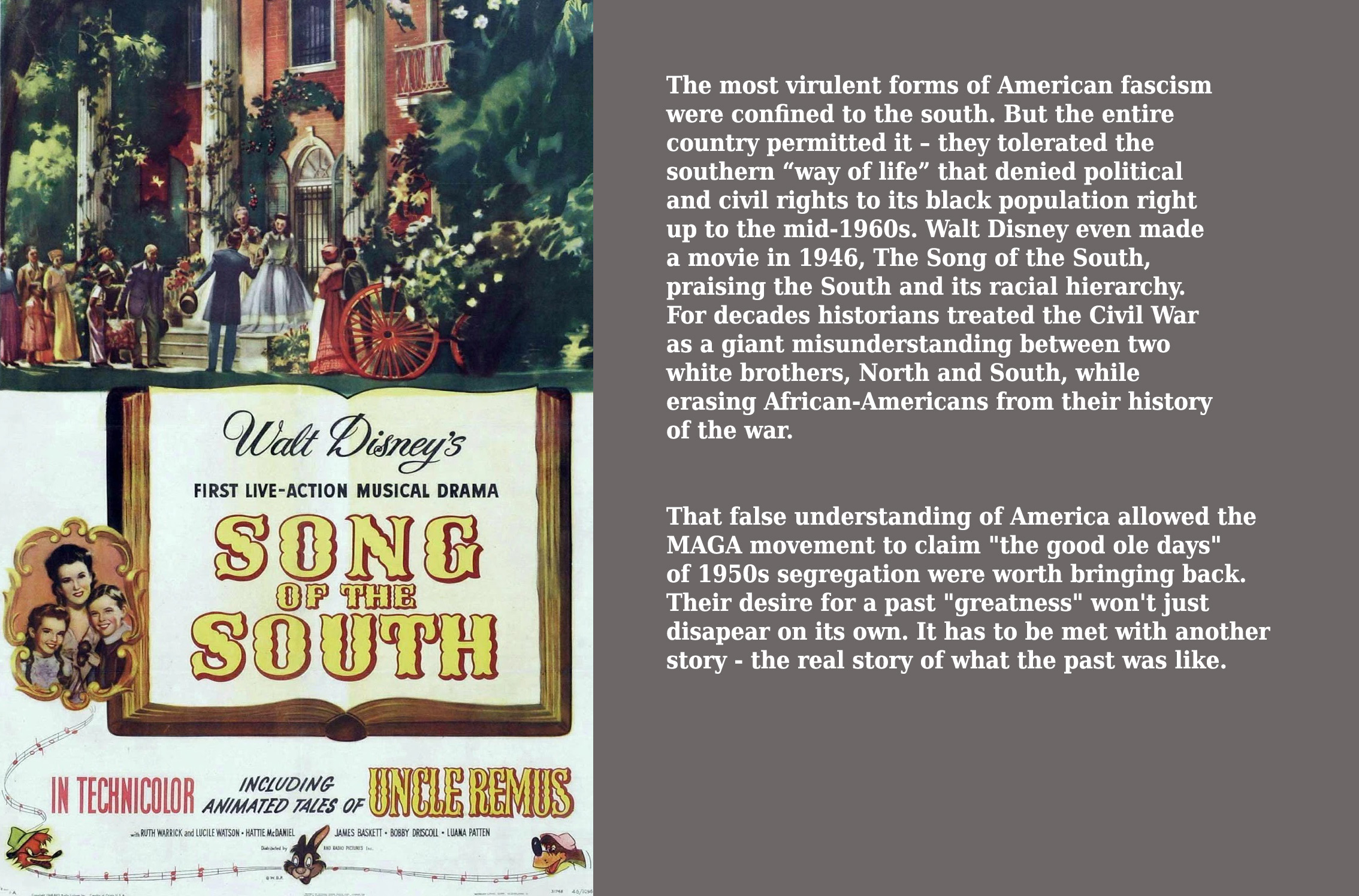
We fight about interpretations of the past because it matters. George Orwell said it best in his classic book,1984:
“Who controls the past controls the future. Who controls the present controls the past.”
Why we need you
American democracy is on the line. Elections in November are crucial. But even if MAGA is defeated in the fall, it's not a movement that will simply disappear; it will return in a new form unless we break the cycle that feeds it. Ignorance of our past is one of those things we must confront.
I'm not going to get grants for this film anywhere in the US, given the current war by the federal government on anything seen as "DEI". Plus, documentary is a tough sell these days, especially documentary critical of the MAGA movement, or one that talks about the US slide into fascism, as I do in this film.
To complete the film and get it to an audience, I need crowdfunding.
But I also need to crowdfund for another reason - I need to start building the audience for the film now. And getting the word out through Seed&Spark crowdfunding is a good way to start. I plan to distribute the film is through what's known as "impact film distribution", going directly to audiences and bypassing the gatekeepers at the streaming companies, companies that aren't going to touch this subject. We aren't going to wait passively for distributor to knock on our door. In the current environment there are very few of those opportunities. This is a film suited for community, college and special interest audiences around the subject of multicultural democracy — exactly the places impact distribution works best.
I plan to use Kinema, the Seed&Spark streaming and distribution partner to reach those audiences. But to get there, we have to first crowdfund our most immediate needs.
Budget breakdown
A lot of effort & money has gone into getting the film to this point: a fine cut of two hours. Here's the breakdown of actual cash, deferments & in-kind spending through 2024. You'll notice that I've put a lot of my company resources & my own time into the film since 1990.
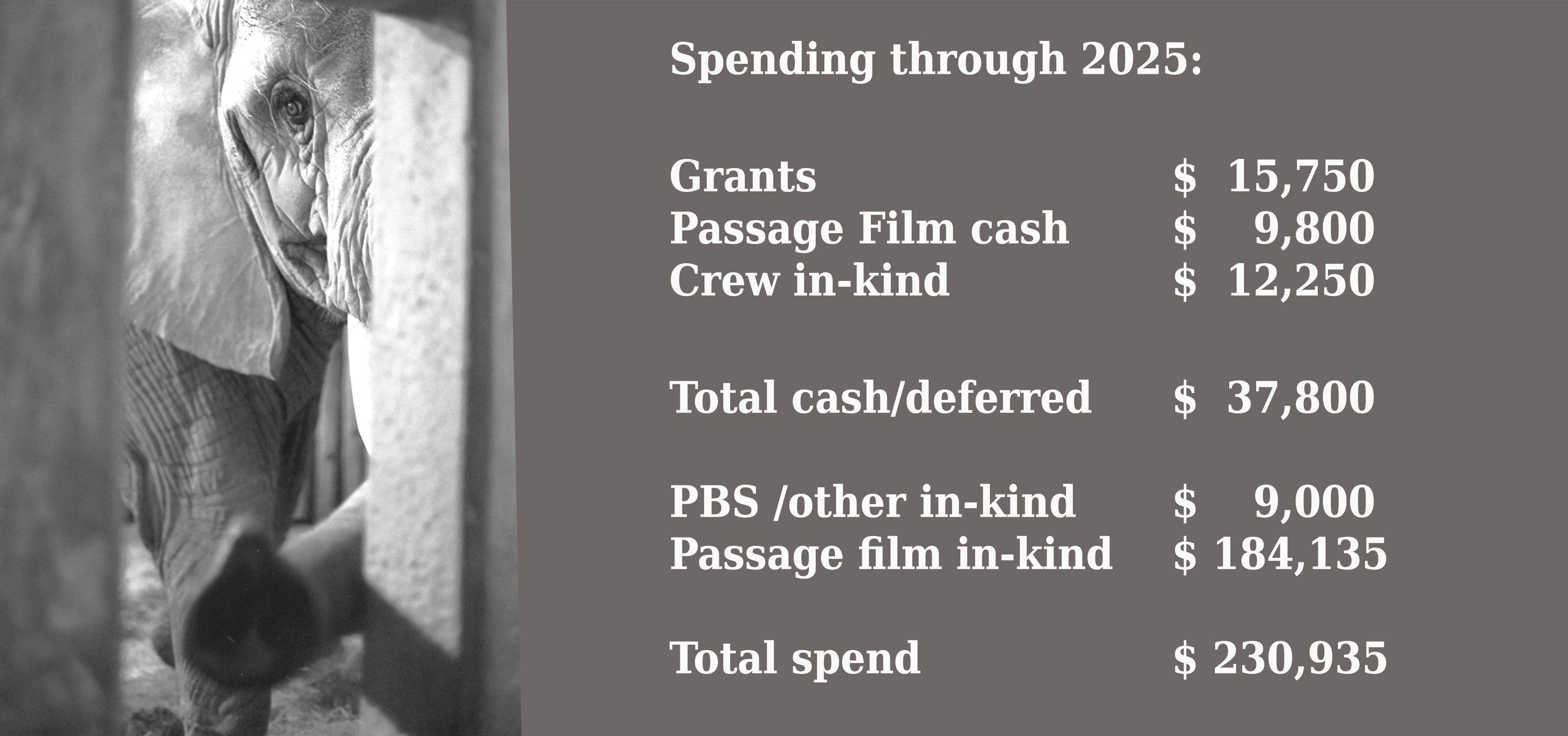
The amounts listed are actual dollars at the time they were spent, so a 1990 dollar is worth quite a bit more today. When spending is adjusted for inflation, the amount invested in the film is $375,484.
PBS/other in-kind spending comes from a PBS station in Bozeman, Montana and Mississippi Educational Television, as it was called before its name change to Mississippi Public Broadcasting. "Other" is the University of Mississippi Communications Resource Center for use of their 8-plate film editing machine in the early 1990s.
Yes, there is an actual elephant in the film and that's him above. An Asian elephant at the Memphis Zoo that I photographed during a visit with my sons in 1989, a year before I started this film. So he's not just rhetorical, although he is that too.
What this crowdfunding gets us
We're crowdfunding through Seed&Spark because we need additional funds to get this film to the finish line. We're aiming for a modest target to meet immediate needs that are blocking us from gettting to final post-production.
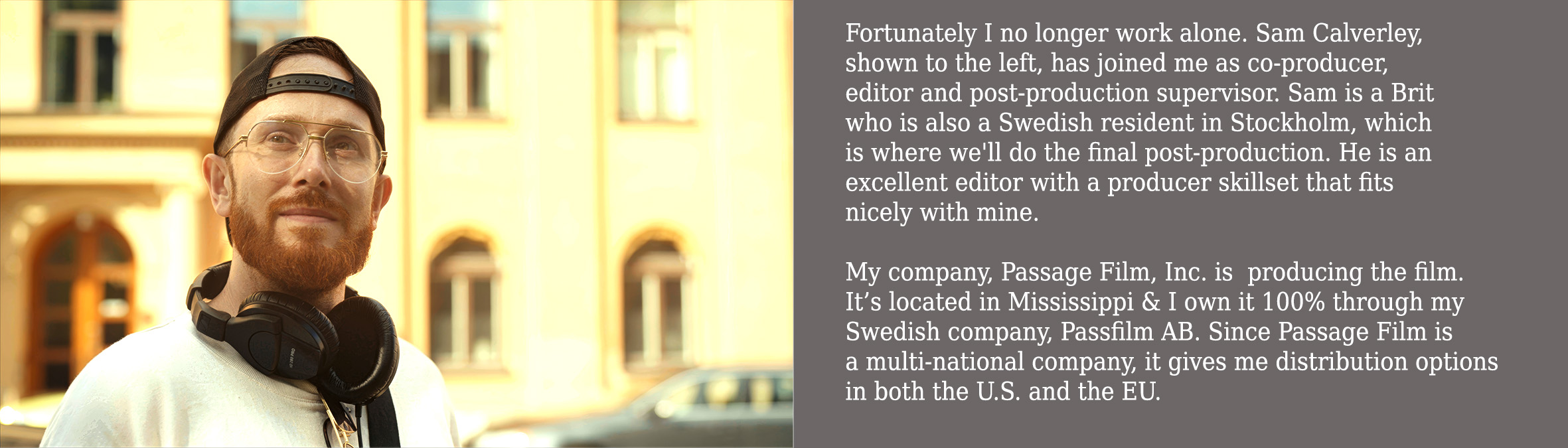
Specifically I need to upgrade my editing to move the film from its current out-of-date Final Cut Pro 7 format into AVID so Sam Calverley, my co-producer & post-production supervisor can prepare the film for final online and color grading. Right now I'm working on an obsolete 2010 Macbook Pro running a Snow Leopard operating system with Final Cut 7. It was state-of-the-art fifteen years ago, but no more. An editing upgrade is essential to reach the 4k online output we need.
Our other pressing need is to scan my 16mm original film to 4K digital. The film is stored at the Southern Historical Archives of the University of North Carolina in Chapel Hill, where I donated my physical film collection, while retaining the rights. I need to travel to UNC to pick up the 16mm film and transport it to Color Lab, in Washington DC for the scanning.
There is also $600 in the crowdfunding to cover film festival entry fees.
Our crowdfunding campaign goal is $16,180, which enables these three most important goals.
 We've already entered the film in several film festivals in the fall of 2026, including the Stockholm Film Festival and the New Orleans Film Festival, with more submissions to come. Sam Calverly and I will continue to work on the film as an in-kind contribution, although I need to pay Sam as soon as I have money for it -- see the next section, stretch goals -- Sam will be preparing the online/colorgrading files.
I'm deferring my own compensation until the film is complete and in distribution.
The people involved in this film
There's me of course. I learned Direct Cinema documentary at NYU Grad Film where i got my MFA in 1981. I've since worked with ethnographic filmmaker William Ferris, from whom I borrowed much of my interview camera-style. My approach to Cinema Verite post-NYU was heavily influenced by Bertrand Tavernier after I worked as his Production Manager on Mississippi Blues in the early 1980s. Here's my IMDB page with a very partial list of my 200 credits. And a short bio page on my website. Also a few photos of me at work here. Enough about me.
My co-producer is Sam Calverley. See below. Also check out what Sam says about himself on the Team page.
As I've worked on editing I've also consulted with film professionals I know in France, Canada, Australia and the US and they've provided invaluable suggestions that helped shape the film. Additionally two friends who are not filmmakers gave me their advice and support. These are their names, with the filmmakers linked to their imdb credit pages - click the name to see the link.
- Alain Choquart
- John Kozak
- Nicholas Holmes
- Neil Novello
- Karen Bennett
- Renee Yates
I also had a team of eight scholars that advised me on historical content and/or reviewed rough cuts to make sure the history is accurate. These are their names and institutions:
- Emily Crosby – SUNY Geneseo (New York)
- W. Ralph Eubanks – University of Mississippi
- William Ferris – University of North Carolina
- Max Grivno – University of Southern Mississippi
- Robert Luckett – Jackson State University
- William Sturkey – University of Pennsylvania
- Alisea Williams-McLeod – University of Chicago
- Charles Reagan Wilson – University of Mississippi
Finally, the contribution of those I interview was crucial, not just to the film, but to my own understanding of this subject.
As I say in the narration to the film:
Looking through a camera lens taught me to see the past with fresh eyes. And I began to listen to voices I hadn’t heard before. The things I saw, the people I met, taught me first hand, the truth of it. That the past is not past.
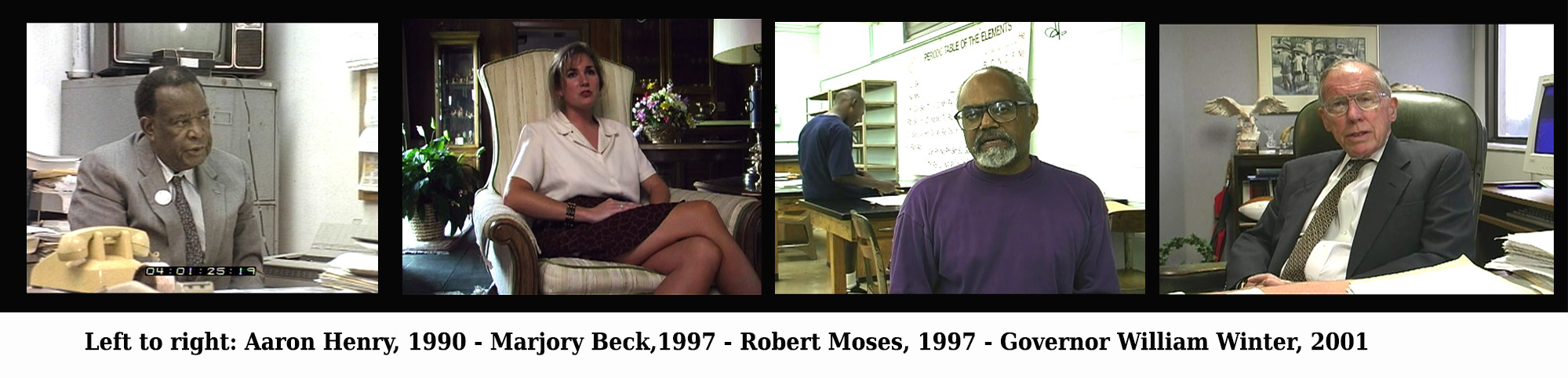
These are people I interview in the film (links included where I could find them):
Arun Gandhi · Flonzie Brown-Wright · Unita Blackwell · Victoria Gray Adams · Marjory Beck · H.C. Franklin · William Dunn · James Meredith · Robert Smith · Aaron Henry · Lowell Grisham · William Christenberry · William Winter · Alisea Williams McLeod · Aston Holley · Susie Marshall · Patricia Young · Peter Aschoff · Willie B. Tankersley · Otis Patton · Robert Moses · Argusta Hicks · Beverly Carter · Lee Eric Smith · Richard Barrett
Of the 25 people listed here, 17 have passed. I'm grateful to all of them, living and dead, for agreeing to step in front of my camera and tell their story. While my own narration is what ties everything together, the full impact of the film comes from what these people have to say.

It would be fantastic to exceed our crowdfunding target. We kept our goals modest because this is the money we need at this point to move forward in the editing. It isn't, however, all the money we need to complete the film. Here's additional expenses we need to get the film into distribution. The elephant is the same one in the budget graphic, that I photographed in 1989. That's my middle son Gabriel touching his trunk, under supervision of the elephant keeper to the right. The film includes the full story of that night, which also becomes the metaphor of the film title.
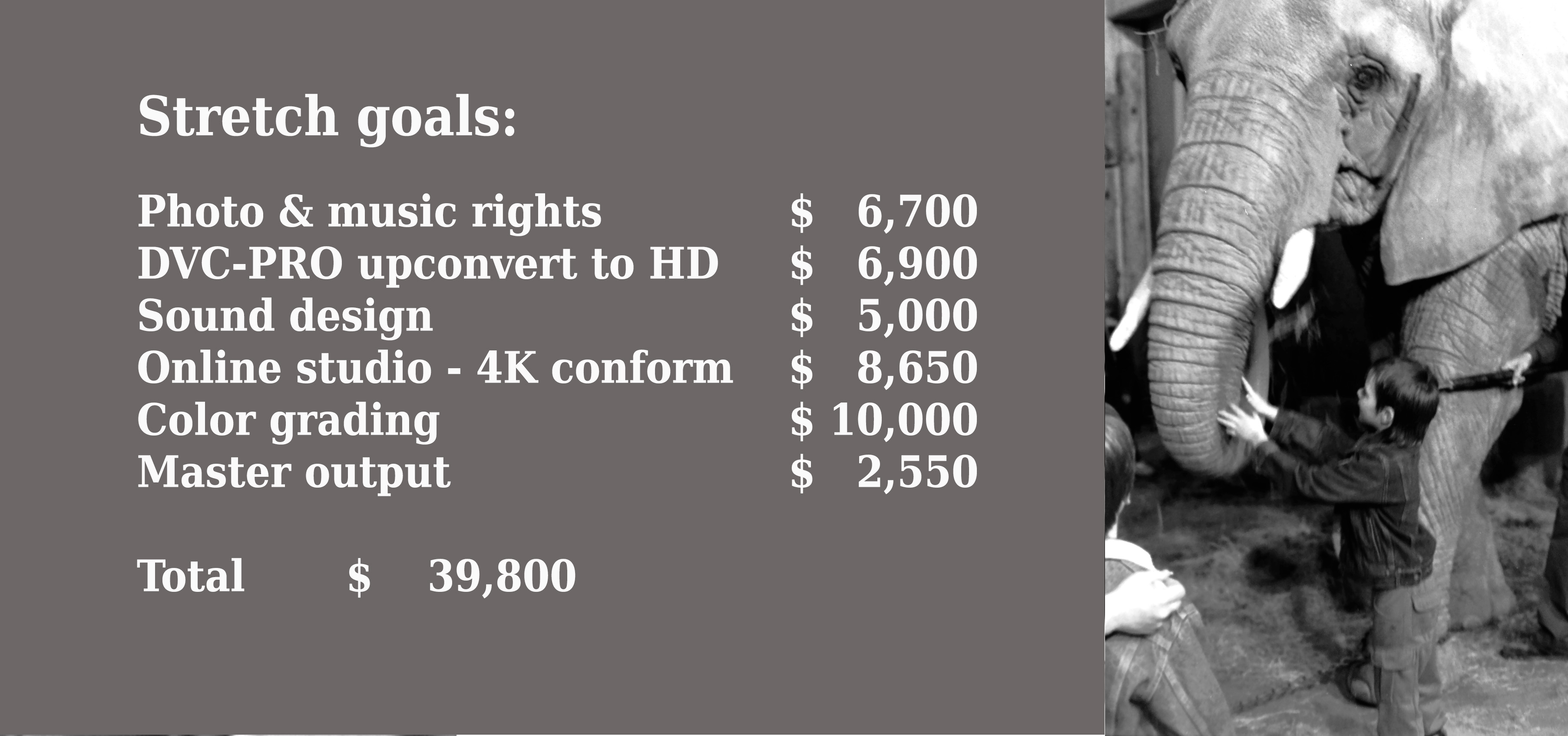
I'm not expecting to cover all of this with stretch goals, in fact I'll be quite happy with raising just the targeted amount. Having said that & if you're feeling generous, t would be lovely to not have to continue to write grants & knock on distribution doors to raise these funds. The less of that I have to do, the sooner I can focus on the distribution of the film.
And the sooner I can start working on Part 2 . . .
The first of three films in a series
This film will be two hours long and it stands on its own. But it will also be the first in a series of three films, all building on each other, with each one edited to also work as a single, stand-alone film.
These are a few images from part 2, which will start where this one leaves off and cover the 1990s rise of southern nationalism, specifically the political battle over the rebel flag and its inclusion in the Mississippi and Georgia state flag. Plus it flew atop the State Capitol in South Carolina. Most of this second film has already been shot; I've also done a rough edit of parts of it. It includes my move to Sweden; the last image below is at my 2009 citizenship ceremony at Stockholm City Hall.
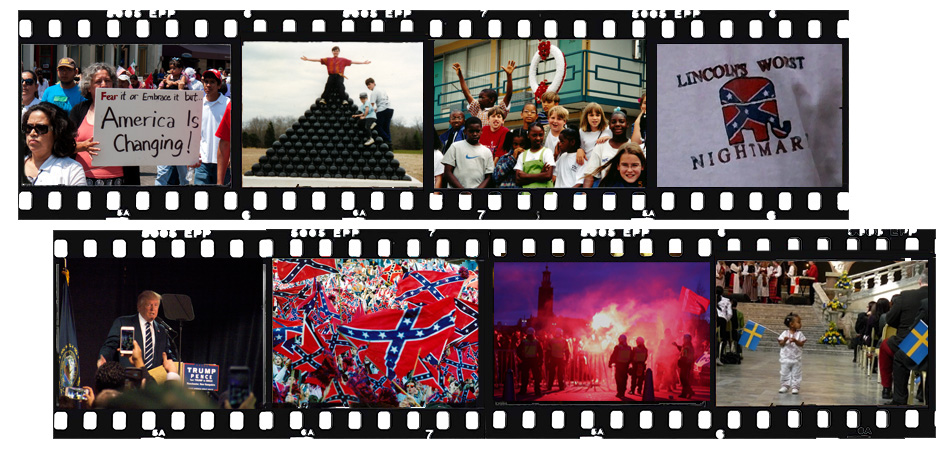
Top left to right: immigration march, San Antonio - my kids at Shiloh Battlefield - my youngest son's class at Memphis Civil Rights Museum - t-shirt logo at pro-rebel flag rally
Bottom left to right: Donald Trump at 2016 rally in New Hampshire - 1990 rebel flags at an Ole Miss football game - 2011 Protests against a Nazis in Stockholm - child at ceremony for new Swedish citizens in Stockholm
This second film follows the rise of southern nationalism around its fight to preserve the rebel flag as part of the Mississippi State Flag. I filmed this conflict throughout the 1990s, ending with a state-wide referendum on the flag in 2001. The rebel flag won the referendum; it was only removed in 2021 through an act of the legislature. Not because they were offended by the flag but because it was hurting college sports.
The theme of the 2nd film is fathers what they pass on to their children. My own father figures prominently in this part of the story — as do my sons who I filmed throughout that decade as they grew up in an integrated and changing Mississippi.
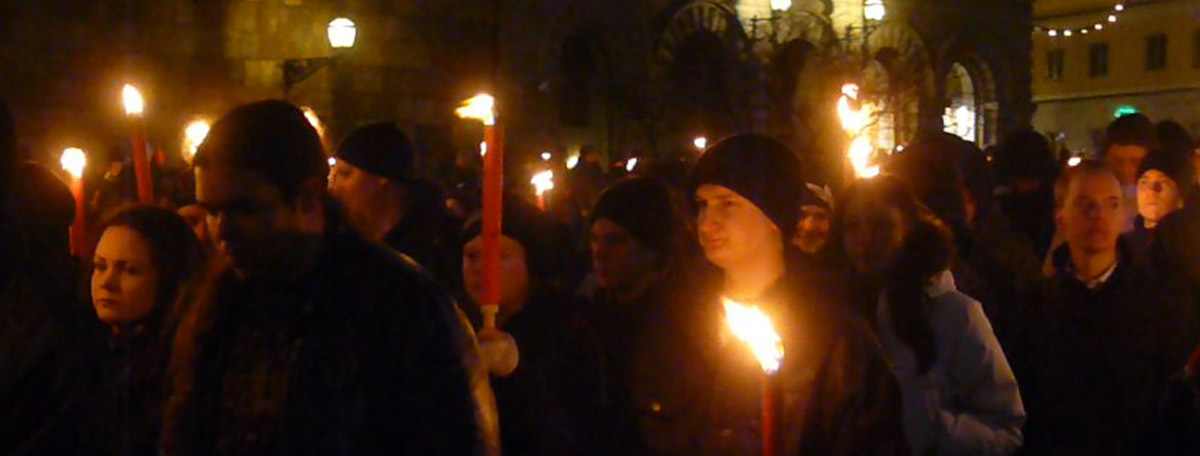
I filmed this Nazi march in Stockholm, December 2011. The British racist, Nick Griffin spoke to them, using much of the same language I heard in the 1990s in Mississippi.
The third film will focus on the rise of Nazis and extremist movements in both the US and Europe. Immigration and multi-cultural democracy in Sweden and the US will also feature prominently. The third film will use more cinema verite shooting and will focus on contemporary events as they occur. Only a little of this film has been shot; making it will depend on the success of the first two films.
Each of these films will also be distributed as a three-part streaming series. When all the films are complete it will be a nine-part series.
If you read this far, thanks very much. If you can support us, please do. If not, thanks anyway -- and it'd be great if you become a follower of the film at Seed & Spark, no contribution is required and you'll get updates on the film's progress..
Wishlist
Use the WishList to Pledge cash and Loan items - or - Make a pledge by selecting an Incentive directly.
AVID MEDIA COMPOSER
Costs $500
The image has me and my obsolete Macbook runnning Pro Final Cut Pro 7. I need to upgrade it to AVID & convert the film to an AVID timeline.
DaVinci Resolve
Costs $300
Getting a timeline from Final Cut 7 to AVID is tricky. You can only do it by first converting into Resolve -- then going Resolve to AVID.
PC workstation fit for AVID
Costs $7,900
Image is a high-end HP workstation. Which I can't afford. But for $7900 I can assemble a good AVID PC with 36 TB NAS drives & monitor.
Personal courier to transport 16mm film from UNC @ North Caroline to DC.
Costs $1,995
Covers car, hotel & food cost to get 16mm to Color-lab in DC for scanning + research at National Archives.
Scanning 16mm film at Color Lab in DC
Costs $4,884
I worked with DVD copies of videotape copies of the original 16mm. The image lost a lot. Cofor Lab is going to scan the original 16mm.
Film Festival Entry Fees
Costs $600
I've entered the film in the Stockholm Film Festival. It was free since I'm also a Swedish filmmaker. But other festivals cost. A lot
If we pass our goal, we can do more...
Costs $1
Amount is a symbolic $1 since I need this $16K now to move forward. But if we pass the goal, I can upres my DVC PRO, mix sound & more.


Direct link:
Share this update!
About This Team
I’m speaking as Kent Moorhead, the Director of this film:
Thi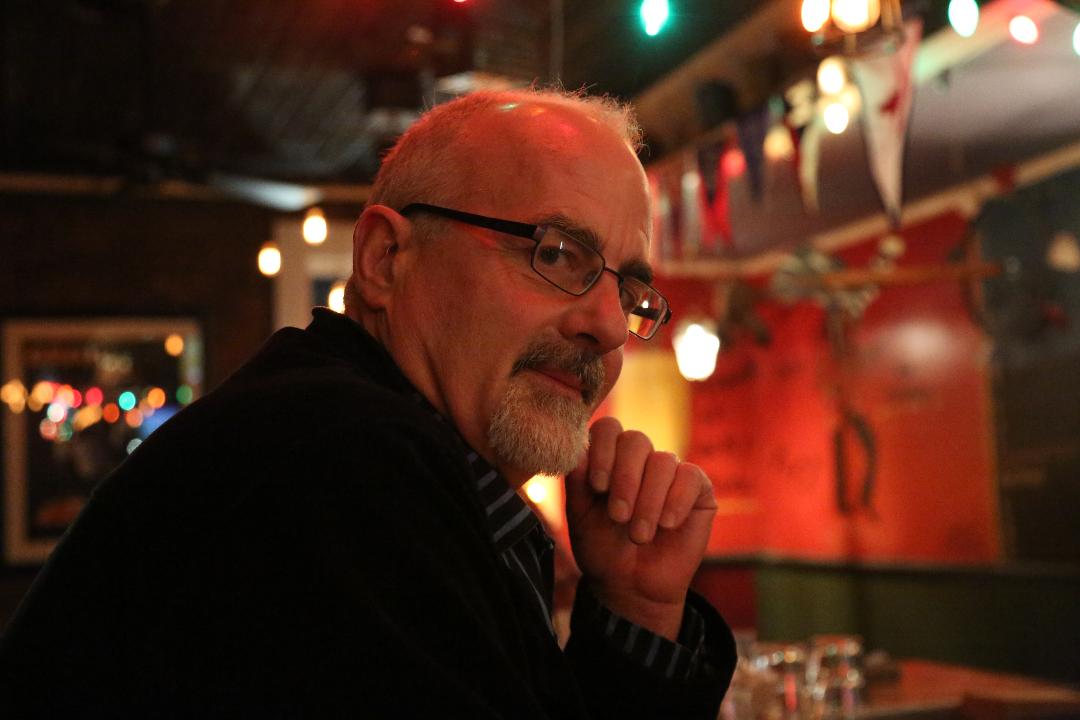 s is personal. It’s a personal documentary, meaning I’m in it. The politics that drive the story are personal too because I lived them. It makes for a film that’s not just personal. It also explains – using history I lived through and saw – how America became what it became.
Trump didn’t invent MAGA, he just gave a name to something that’s been with us for a long, long time. Unless we see this thing, understand it, and change the underlying dynamics that pass it from generation to generation like a precious heirloom, then we’ll stay on our hyper-phobic, racist merry-go-round forever. My hope is to open people’s eyes to what was, so we can change what’s to come.
I was born in 1954, a week after the historic Supreme Court decision shook the South by integrating its schools. The Supreme Court was bold in what it said, but timid in its demand. It gave the south all the time in the world to end segregation and because of that I didn’t attend an integrated school until 1970 when I was sixteen.
At the time it was happening, much of this history was hidden to me because I was a child. My filmmaking gave me a chance to meet and listen to some of the most important Mississippi civil rights leaders and learn first-hand what had really happened. Or in the words I use in the narration that opens the film:
– Looking through a camera lens taught me to see the past with fresh eyes. And I began to listen to voices I hadn’t heard before . . . The things I saw, the people I met, taught me first hand, the truth of it. That the past is not past.
Speaking as Sam Calverley, the Co-producer & Editor/Post-Production Supervisor on the film:
My name is Samuel Calverley, and I am a queer filmmaker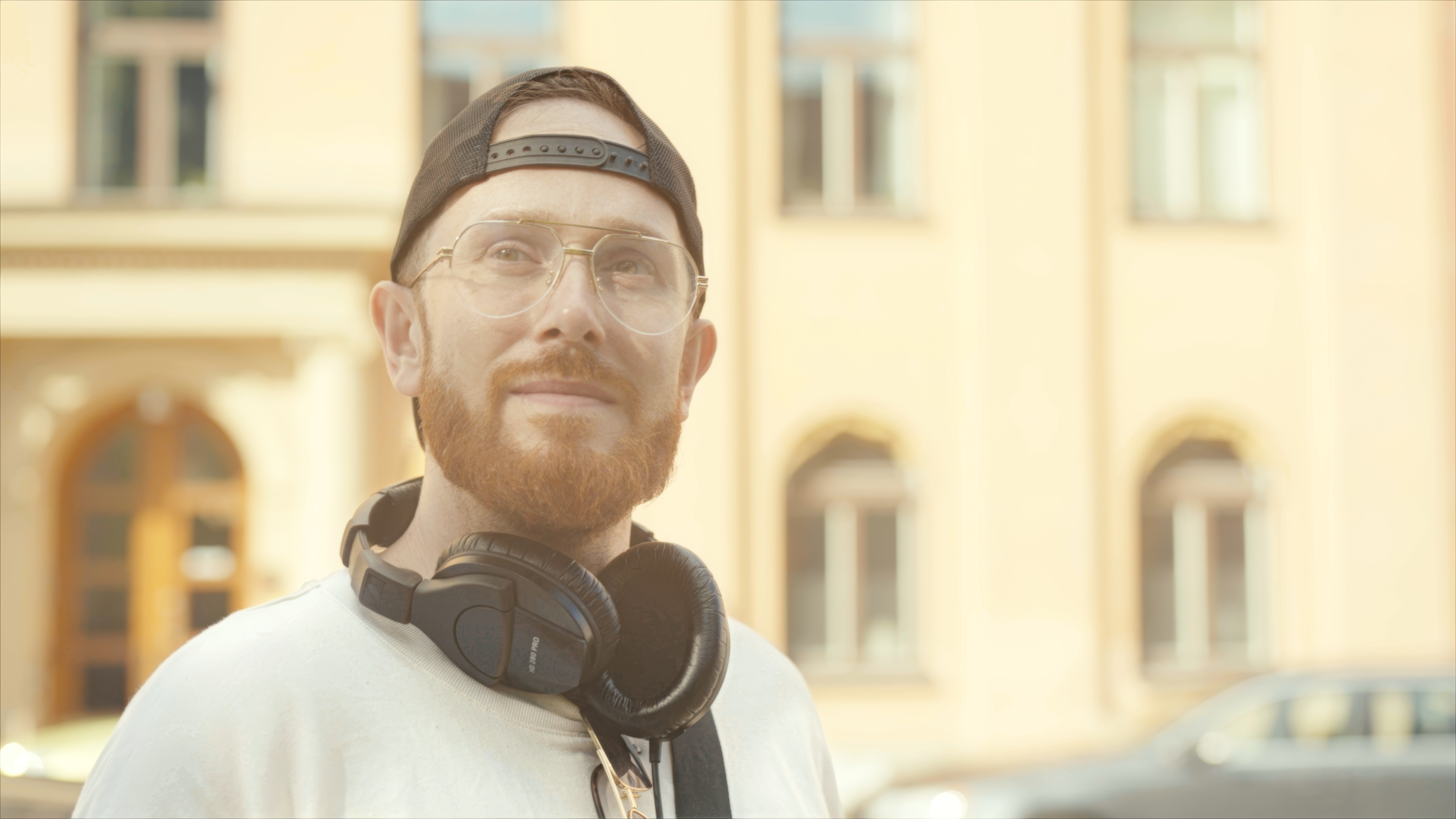 from the UK, now resident in Stockholm Sweden.
I've been in the industry for 15 years, working my way up through running to editing, from daytime to primetime and now streamers. I have had a career that spans across continents, working with ACE editors, directors of Oscar winning films and producers who know their craft and are honed on their goals of bringing something to the screen which will excite, inform and spark conversations. exist as a point of privilege, A white cis male, living in a country with one of the highest standards of life there is. But for me, under the surface, I am a queer person, an immigrant myself, the son of an immigrant mother, raised by three powerful, immigrant women of color, who taught me to be the best version of myself and to stand up for what is right.
The stories that excite me, push against the status quo. Powerful Women, Queer individuals, Trans activists, People of Color, the stories I want to make, push buttons, throws out rule books and tell the stories of people who matter, their stories, from their words of how they want to change the world for the better.
The Elephant in the Room is a passionate personal story of Kent Moorhead, and through lens after lens, decade after decade the revelation that the people he grew up with and opposed are the same people we fight today, just another generation. Until we learn from our past and learn to spot the systems that control us, the past will never be past.
Current Team
Incentives
- The Story
- Wishlist
- Updates
- The Team
- Community
Mission Statement
The Story
Poster for The Elephant in the Room: an american story - design by John Ennis
The story is about growing up in a troubled time and how a child accepts it as normal while also struggling to understand what is happening. In my case it was about civil rights & the violent reaction against it.This film comes from that personal struggle.
America is in crisis because the past I grew up with didn’t stay in the past, it returned in new forms. The agents of ICE aren't the Ku Klux Klan, which in its day was backed by police and politicians both. But ICE draws from and is sustained by that past.
The past is not dead – collage by Kent Moorhead using a William Christenberry painting & film of an ICE agent in a skeleton mask.
A return to the past describes the MAGA movement too, which owes a lot to George Wallace’s 1968 run for President. Wallace was a southern politician fighting against civil rights and he won 13.5% of the country and 46 electoral votes. Half of his voters were outside the south, proving that southern-style racism had national appeal.
Wallace voters filled Madison Square Garden in New York during his 1968 campaign.
In 1997 I interviewed SNCC activist Victoria Gray Adams to talk about Civil Rights & those who opposed it. SNCC stands for student Nonviolent Coordinating Committee, one of the most important Civil Rights organizations working in Mississippi.
Victoria Gray Adams gave the country responsibility for what happened in Mississippi – and was ahead of her time in saying we had a long way to go. I include her on-camera quote in the film:
"The only reason Mississippi could exist was because the rest of the country permitted it. And so it was no longer a struggle just with Mississippi. It was a national struggle and it still is."
This film confronts our white supremacist past. It pivots on a key historical moment when a Constitutional crisis in Mississippi forced President Kennedy to make a choice, a choice between equal rights or racism.
Military Police in Mississippi the morning after the riot/insurrection at Ole Miss. October 1, 1962.
The riot began on a September night. It soon became a full-blown insurrection against the federal government. President Kennedy sent the army’s best to stop it, including the 101st Airborne and the First Army Division, integrated with both black & white soldiers. Over 30,000 troops came to North Mississippi to put down the rebellion. No one talks about it now, almost no one even remembers it.
I think about it all the time. I was an eight-year-old boy who saw it happen. As I explain in my narration to this film:
“It was history raw and first-hand, and I had a front row seat. But I had no one to explain it to me.”
This film is the result of 35 years of filming this story, trying to understand what happened that September night. Learning everything that led up to it, and everything that followed. Trying to understand it so I could explain it.
It happened exactly 100 years after General U.S. Grant occupied/liberated my hometown of Oxford during the Civil War. A war that turned slaves into soldiers, as southern black men fought for freedom in the Union Army. After the war they gained both civil rights and the vote.
Former Confederates never accepted the equality promised by the Declaration of Independence. When they violently seized power at the end of Reconstruction, they created a new form of oppression based in white supremacy: Jim Crow segregation.
"Separate but Equal" segregation in a 1950s rural Mississippi school for black students. My dad was an educator. This photo from the Phay Collection in the Ole Miss archives was taken by his colleagues at The University of Mississippi as proof that separate meant unequal.
In 1954 the Supreme Court overturned its earlier ruling that legalized segregation, saying that separate schools led to unequal treatment of citizens and was therefore illegal. They ordered the desegregation of public schools.
News photograph from Monday, May 17, 1954 after the Supreme Court reversed 58 years of legal apartheid in the United States.
I was born exactly a week after that decision and it shaped my whole life – and creates the story arc of this film. The Court ended segregation but without setting a deadline. Mississippi and Alabama refused to change and up to 1961 nothing happened. Until James Meredith applied to become the first black student at the University of Mississippi, locally known as “Ole Miss”. The Governor said no, claiming Mississippi segregation law “nullified” the Supreme Court ruling. Federal Courts disagreed and ordered that Ole Miss admit Meredith.
Governor Ross Barnett and Meredith both saw the same thing — that integration of Ole Miss would sooner or later bring about the fall of Jim Crow Segregation in Mississippi and the rest of the south. Which it did.
President Kennedy was looking for a compromise. He wanted to placate Southern racists who were also Democrats and whose votes he needed in the upcoming 1964 election. But there was no middle ground between white supremacy and equality. Kennedy had to choose.
The marshals came with tear gas and riot gear. They wore helmets and had Smith & Wesson revolvers. And orders not to use them.
This was no spontaneous riot. it was a planned insurrection with behind-the-scene support and money from the most powerful men in Mississippi and the south.
The mob began throwing bricks and concrete cinder blocks. Then bottles of acid. Followed by molotov cocktails. Soon the crack of high powered rifles filled the air as US Marshals were hit with gunfire. William Dunn was a marshal that night. He was on the front lines of the fight, with tear gas as their only weapon to keep the mob at bay. Dunn told me this:
"We had over a hundred men that were wounded by gunfire. When men beside you fall from gunfire, and you don’t return that fire, it takes a helluva man to do that. You don’t realize what would have happened, had we turned those weapons loose. There would have been hundreds if not thousands of casualties".
Kennedy had no choice but to send the army. The alternative was slaughter of the federal men or an explosion of violence throughout the south if they fought back with guns — exactly the bloodshed the insurrectionists wanted. They were hoping to create a revolt that would spread to all the southern states. Dunn’s interview describes his relief as the first troops arrived and the dynamic changed. The film and photographs that survived that night illustrate Dunn’s vivid storytelling – which I mix with my own memories. A time that has haunted me ever since.
What does that long-ago September night in Mississippi say about the January 6th Insurrection?
I filmed my TV as CNN described the insurrrection of January 6, 2021. I couldn't believe what I was seeing.
When the Trump mob stormed the US capitol on that January six, the past up and hit me in the face. I was watching CNN from my home in Sweden — which is where I live now. I couldn't believe thousands of men would be so bold, so disrespectful, so anti-democratic as to attack the Capitol, trying to overturn an election. In 1962 it was insurrection against civil rights and our Constitution. What happened on January 6, 2021 was an echo of the same thing. Down to the rebel flags carried by the mob.
A man in the J6 mob carries a rebel flag into the Capitol - something Confederates never succeeded in doing during the Civil War. Photography by Mike Theiler| Credit: REUTERS
The story of that night at Ole Miss is the pivot point of the film, but it's the years before and the years after that are the main thing, with a focus on how our past created what we face today.
Ole Miss professor James Silver wrote The Closed Society describing how white supremacy controlled everything in Mississippi. He identified the central conflict of 1962 as one between white supremacy and multi-racial democracy. Which is the same battle we face today.
This is a story with the sweep of history behind it. But it's personal, it's told through my eyes as I lived it. It's also a film created over decades, which makes it unique because I didn't stay the same through those years. I changed. You'll see the kind of things I talked about when I started filming in 1990, the questions then. You see my kids too, who I raised in the same place I was born. Except they grew up in an integrated south, attending integrated schools. You also see how I talk in the present day. Because of when I was born and where I grew up, the larger story I tell happens to be the same as my personal story.
It was MAGA before its time. The Citizens' Councils controlled most media in the state and through that they controlled the politics. They sponsored a radio program that promoted white supremacy and was broadcast nation-wide. Thanks to the Citizens' Councils, Mississippi created its own secret police; it was a new state agency with a strange name — the Sovereignty Commission. Some jokingly called it "the Kudzu KGB". But it was no joke, it was as pervasive and ruthless as the East German Stasi. The film has a personal story of mine about that too.
The film also describes the racial violence in the South including lynching, interpreting that past through my own experience. As I point out in the film, I grew up around men who had blood on their hands. I didn’t know it at the time but they had participated in Oxford’s last lynching in 1936.
Aston Holley was a boy when the lynching occured and he and his friends watched the lynch mob as it gathered. I learned that some of the men in that lynch mob reprised their real-life role as film extras for the lynching scene in the 1949 Hollywood film, Intruder in the Dust, based on the book by William Faulkner. I can't look at that film anymore without wondering about the men around me when I grew up. Some were actually in the mob. The others stayed silent.
Many people thought the battle over civil rights ended with the 1964 Civil Rights Act and the 1965 Voting Rights Act. But I attended segregated schools right up to 1970. My experience of integration comes toward the end of the film, which was an amazing time. In a very good way.
In the decades that followed, it seemed there really was a new South and a new country. Despite the southern backsliding on race that followed, Barack Obama became the first Black President in 2008. Pundits declared the country to be "post-racial". As it turned out, that was a mirage.
This film explains why. It shows how the white supremacy and racism of George Wallace was the forerunner of Trump's MAGA movement. It helps the viewer see that Donald Trump didn't create MAGA, he just gave it a name.
A picture I took at the 2017 MOAR Rally ("Mother of All Rallies") on the National Mall in Washington, in support of Donald Trump.
Americans voted to take the US down this path. It's resulted in violent and often illegal deportations; Elon Musk taking a literal & budgetary chain saw to the federal government; and Trump threatening American cities that oppose him. The film relates these things to the white supremacist policies now embedded in MAGA; and it contrasts it to the diversity that actually made America great.
I took this snap on a spring day in San Antonio as tourists posed for photographs in front of the Alamo.
Oxford High School cheerleaders after integration, 1971. This image comes from my High School Annual.
"The past is not not dead, it's not even past" can sound threatening depending on which past it means. But it also points to hope because we aren’t doomed to repeat just any past. We choose the past we keep and pass on to our children.
We change the past too, when we build on what heals and discard what hurts. My story includes that part of our past as well. It tells the story of the integration of my high school, when I joined with a group of black and white students on the student council to fight for the right to meet and interact socially with each other – something our Superintendent of Schools was trying to stop.
1971. That’s me in a student council meeting at Oxford High School.
The film moves back and forth through time to link past, present and future. The legacy of Abraham Lincoln is both past history and something still with us today.
Lincoln talked of “a new nation, conceived in Liberty, and dedicated to the proposition that all men are created equal.” During his Gettysburg Address he said:
“Now we are engaged in a great civil war, testing whether that nation, or any nation so conceived and so dedicated, can long endure.”
Our testing didn’t end with the Civil War. It’s with us, still forcing us to choose what kind of nation we want to be.
I've been at this a long time. The first 16mm film rolled through my camera in November of 1990. Thirty-five years ago. I had grants from the arts group Appalshop in Kentucky and the South Carolina Arts Commission and was able to begin filming with an experienced crew. I met my cameraman John Thomas, when I was a student at NYU Grad Film in the late 1970s. During planning, John and I decided that I would appear on-camera as a character in the film, which set the style I would continue throughout the making of the film.
From 1990 to 1993 I filmed in Oxford, Mississippi; Jackson, Mississippi; Memphis, Tennessee, Shiloh Battlefield; and Washington, D.C.
Brit Warner did sound on those shoots. Brit’s an excellent sound mixer who’s worked extensively in TV and film out of Atlanta. When I have the budget for it I use double-system sound recording, which gives you both high-quality sound and full freedom of movement for the camera.
The image below is Brit recording sound as I listen to a man named Mr. Godwin playing blues on his back porch.
In 1994 I showed the first edit of this film at the Independent Film Market in New York. It was a 30 minute work-in-progess with the title: Robert E. Lee May Have Surrendered But I didn’t: A Short History of the Rebel Flag. My film was about the underlying issues of race, white supremacy and the history behind it all, especially slavery and Jim Crow segregation
The audience seemed interested. Buyers weren’t.
In the mid-90s I ran out of money. The flag had become a toxic subject and I could no longer get grants to continue the film. I began to self-finance through my film company, Passage Film, Inc.
Sometimes I had to record sound myself as well. When I had money – as I did for many of the Civil Rights interviews – I used a very good Oxford soundman, Bennie Walls, That's Bennie in the image below, recording sound as I interviewed Civil Rights activist Flonzie Brown-Wright in Canton, Mississippi.
This film draws from the filming I did about the rebel flag; as well as additional work about the Mississippi Civil Rights Movement. Plus extensive filming of James Meredith and the Ole Miss insurrection of 1962, films about African-American in the Civil War and World War II, plus my filming of race relations in Mississippi. I also have an extensive collection of family photographs and 8mm film as well as my own still photography – all of which I use in telling this story.
What I discovered in filming over three decades was that I covered the beginning of a political movement. In the 1990s it was about hanging on to the symbols of the past, but more than that. Hanging onto those attitudes as well.
America is in a long-running conflict over multicultural democracy and it’s reflected in my own story.
As James Meredith puts it in his 2005 interview:
". . . its about citizenship and the rights and privileges of citizenship
and who’s going to enjoy them. And my goal has always been 100%."
The Signficance of the film
People in America and around the world see the USAs rapid plunge into fascism after Donald Trump’s return to the Presidency and can’t believe it’s real: how did the U.S. get here so fast? The Elephant in the Room: an american story shows that the US always had a version of fascism in its politics, starting with slavery and continuing with the Jim Crow era of segregation. Few know, for instance, that the Nazi anti-Jewish Nuremburg Laws were inspired by the segregation law of Mississippi and other Southern US states. It wasn't just Nazis that looked south for inspiration. Films like Birth of a Nation, Gone with the Wind & Disney's Song of the South celebrated southern white supremacy.
We fight about interpretations of the past because it matters. George Orwell said it best in his classic book,1984:
“Who controls the past controls the future. Who controls the present controls the past.”
Why we need you
American democracy is on the line. Elections in November are crucial. But even if MAGA is defeated in the fall, it's not a movement that will simply disappear; it will return in a new form unless we break the cycle that feeds it. Ignorance of our past is one of those things we must confront.
I'm not going to get grants for this film anywhere in the US, given the current war by the federal government on anything seen as "DEI". Plus, documentary is a tough sell these days, especially documentary critical of the MAGA movement, or one that talks about the US slide into fascism, as I do in this film.
To complete the film and get it to an audience, I need crowdfunding.
But I also need to crowdfund for another reason - I need to start building the audience for the film now. And getting the word out through Seed&Spark crowdfunding is a good way to start. I plan to distribute the film is through what's known as "impact film distribution", going directly to audiences and bypassing the gatekeepers at the streaming companies, companies that aren't going to touch this subject. We aren't going to wait passively for distributor to knock on our door. In the current environment there are very few of those opportunities. This is a film suited for community, college and special interest audiences around the subject of multicultural democracy — exactly the places impact distribution works best.
I plan to use Kinema, the Seed&Spark streaming and distribution partner to reach those audiences. But to get there, we have to first crowdfund our most immediate needs.
Budget breakdown
A lot of effort & money has gone into getting the film to this point: a fine cut of two hours. Here's the breakdown of actual cash, deferments & in-kind spending through 2024. You'll notice that I've put a lot of my company resources & my own time into the film since 1990.
The amounts listed are actual dollars at the time they were spent, so a 1990 dollar is worth quite a bit more today. When spending is adjusted for inflation, the amount invested in the film is $375,484.
PBS/other in-kind spending comes from a PBS station in Bozeman, Montana and Mississippi Educational Television, as it was called before its name change to Mississippi Public Broadcasting. "Other" is the University of Mississippi Communications Resource Center for use of their 8-plate film editing machine in the early 1990s.
Yes, there is an actual elephant in the film and that's him above. An Asian elephant at the Memphis Zoo that I photographed during a visit with my sons in 1989, a year before I started this film. So he's not just rhetorical, although he is that too.
What this crowdfunding gets us
We're crowdfunding through Seed&Spark because we need additional funds to get this film to the finish line. We're aiming for a modest target to meet immediate needs that are blocking us from gettting to final post-production.
Specifically I need to upgrade my editing to move the film from its current out-of-date Final Cut Pro 7 format into AVID so Sam Calverley, my co-producer & post-production supervisor can prepare the film for final online and color grading. Right now I'm working on an obsolete 2010 Macbook Pro running a Snow Leopard operating system with Final Cut 7. It was state-of-the-art fifteen years ago, but no more. An editing upgrade is essential to reach the 4k online output we need.
Our other pressing need is to scan my 16mm original film to 4K digital. The film is stored at the Southern Historical Archives of the University of North Carolina in Chapel Hill, where I donated my physical film collection, while retaining the rights. I need to travel to UNC to pick up the 16mm film and transport it to Color Lab, in Washington DC for the scanning.
There is also $600 in the crowdfunding to cover film festival entry fees.
Our crowdfunding campaign goal is $16,180, which enables these three most important goals.
We've already entered the film in several film festivals in the fall of 2026, including the Stockholm Film Festival and the New Orleans Film Festival, with more submissions to come. Sam Calverly and I will continue to work on the film as an in-kind contribution, although I need to pay Sam as soon as I have money for it -- see the next section, stretch goals -- Sam will be preparing the online/colorgrading files.
I'm deferring my own compensation until the film is complete and in distribution.
The people involved in this film
There's me of course. I learned Direct Cinema documentary at NYU Grad Film where i got my MFA in 1981. I've since worked with ethnographic filmmaker William Ferris, from whom I borrowed much of my interview camera-style. My approach to Cinema Verite post-NYU was heavily influenced by Bertrand Tavernier after I worked as his Production Manager on Mississippi Blues in the early 1980s. Here's my IMDB page with a very partial list of my 200 credits. And a short bio page on my website. Also a few photos of me at work here. Enough about me.
My co-producer is Sam Calverley. See below. Also check out what Sam says about himself on the Team page.
As I've worked on editing I've also consulted with film professionals I know in France, Canada, Australia and the US and they've provided invaluable suggestions that helped shape the film. Additionally two friends who are not filmmakers gave me their advice and support. These are their names, with the filmmakers linked to their imdb credit pages - click the name to see the link.
- Alain Choquart
- John Kozak
- Nicholas Holmes
- Neil Novello
- Karen Bennett
- Renee Yates
I also had a team of eight scholars that advised me on historical content and/or reviewed rough cuts to make sure the history is accurate. These are their names and institutions:
- Emily Crosby – SUNY Geneseo (New York)
- W. Ralph Eubanks – University of Mississippi
- William Ferris – University of North Carolina
- Max Grivno – University of Southern Mississippi
- Robert Luckett – Jackson State University
- William Sturkey – University of Pennsylvania
- Alisea Williams-McLeod – University of Chicago
- Charles Reagan Wilson – University of Mississippi
Finally, the contribution of those I interview was crucial, not just to the film, but to my own understanding of this subject.
As I say in the narration to the film:
Looking through a camera lens taught me to see the past with fresh eyes. And I began to listen to voices I hadn’t heard before. The things I saw, the people I met, taught me first hand, the truth of it. That the past is not past.
These are people I interview in the film (links included where I could find them):
Arun Gandhi · Flonzie Brown-Wright · Unita Blackwell · Victoria Gray Adams · Marjory Beck · H.C. Franklin · William Dunn · James Meredith · Robert Smith · Aaron Henry · Lowell Grisham · William Christenberry · William Winter · Alisea Williams McLeod · Aston Holley · Susie Marshall · Patricia Young · Peter Aschoff · Willie B. Tankersley · Otis Patton · Robert Moses · Argusta Hicks · Beverly Carter · Lee Eric Smith · Richard Barrett
Of the 25 people listed here, 17 have passed. I'm grateful to all of them, living and dead, for agreeing to step in front of my camera and tell their story. While my own narration is what ties everything together, the full impact of the film comes from what these people have to say.
It would be fantastic to exceed our crowdfunding target. We kept our goals modest because this is the money we need at this point to move forward in the editing. It isn't, however, all the money we need to complete the film. Here's additional expenses we need to get the film into distribution. The elephant is the same one in the budget graphic, that I photographed in 1989. That's my middle son Gabriel touching his trunk, under supervision of the elephant keeper to the right. The film includes the full story of that night, which also becomes the metaphor of the film title.
I'm not expecting to cover all of this with stretch goals, in fact I'll be quite happy with raising just the targeted amount. Having said that & if you're feeling generous, t would be lovely to not have to continue to write grants & knock on distribution doors to raise these funds. The less of that I have to do, the sooner I can focus on the distribution of the film.
And the sooner I can start working on Part 2 . . .
The first of three films in a series
This film will be two hours long and it stands on its own. But it will also be the first in a series of three films, all building on each other, with each one edited to also work as a single, stand-alone film.
These are a few images from part 2, which will start where this one leaves off and cover the 1990s rise of southern nationalism, specifically the political battle over the rebel flag and its inclusion in the Mississippi and Georgia state flag. Plus it flew atop the State Capitol in South Carolina. Most of this second film has already been shot; I've also done a rough edit of parts of it. It includes my move to Sweden; the last image below is at my 2009 citizenship ceremony at Stockholm City Hall.
Top left to right: immigration march, San Antonio - my kids at Shiloh Battlefield - my youngest son's class at Memphis Civil Rights Museum - t-shirt logo at pro-rebel flag rally
Bottom left to right: Donald Trump at 2016 rally in New Hampshire - 1990 rebel flags at an Ole Miss football game - 2011 Protests against a Nazis in Stockholm - child at ceremony for new Swedish citizens in Stockholm
This second film follows the rise of southern nationalism around its fight to preserve the rebel flag as part of the Mississippi State Flag. I filmed this conflict throughout the 1990s, ending with a state-wide referendum on the flag in 2001. The rebel flag won the referendum; it was only removed in 2021 through an act of the legislature. Not because they were offended by the flag but because it was hurting college sports.
The theme of the 2nd film is fathers what they pass on to their children. My own father figures prominently in this part of the story — as do my sons who I filmed throughout that decade as they grew up in an integrated and changing Mississippi.
I filmed this Nazi march in Stockholm, December 2011. The British racist, Nick Griffin spoke to them, using much of the same language I heard in the 1990s in Mississippi.
The third film will focus on the rise of Nazis and extremist movements in both the US and Europe. Immigration and multi-cultural democracy in Sweden and the US will also feature prominently. The third film will use more cinema verite shooting and will focus on contemporary events as they occur. Only a little of this film has been shot; making it will depend on the success of the first two films.
Each of these films will also be distributed as a three-part streaming series. When all the films are complete it will be a nine-part series.
If you read this far, thanks very much. If you can support us, please do. If not, thanks anyway -- and it'd be great if you become a follower of the film at Seed & Spark, no contribution is required and you'll get updates on the film's progress..
Wishlist
Use the WishList to Pledge cash and Loan items - or - Make a pledge by selecting an Incentive directly.
AVID MEDIA COMPOSER
Costs $500
The image has me and my obsolete Macbook runnning Pro Final Cut Pro 7. I need to upgrade it to AVID & convert the film to an AVID timeline.
DaVinci Resolve
Costs $300
Getting a timeline from Final Cut 7 to AVID is tricky. You can only do it by first converting into Resolve -- then going Resolve to AVID.
PC workstation fit for AVID
Costs $7,900
Image is a high-end HP workstation. Which I can't afford. But for $7900 I can assemble a good AVID PC with 36 TB NAS drives & monitor.
Personal courier to transport 16mm film from UNC @ North Caroline to DC.
Costs $1,995
Covers car, hotel & food cost to get 16mm to Color-lab in DC for scanning + research at National Archives.
Scanning 16mm film at Color Lab in DC
Costs $4,884
I worked with DVD copies of videotape copies of the original 16mm. The image lost a lot. Cofor Lab is going to scan the original 16mm.
Film Festival Entry Fees
Costs $600
I've entered the film in the Stockholm Film Festival. It was free since I'm also a Swedish filmmaker. But other festivals cost. A lot
If we pass our goal, we can do more...
Costs $1
Amount is a symbolic $1 since I need this $16K now to move forward. But if we pass the goal, I can upres my DVC PRO, mix sound & more.
Direct link:
Share this update!
About This Team
I’m speaking as Kent Moorhead, the Director of this film:
This is personal. It’s a personal documentary, meaning I’m in it. The politics that drive the story are personal too because I lived them. It makes for a film that’s not just personal. It also explains – using history I lived through and saw – how America became what it became.
Trump didn’t invent MAGA, he just gave a name to something that’s been with us for a long, long time. Unless we see this thing, understand it, and change the underlying dynamics that pass it from generation to generation like a precious heirloom, then we’ll stay on our hyper-phobic, racist merry-go-round forever. My hope is to open people’s eyes to what was, so we can change what’s to come.
I was born in 1954, a week after the historic Supreme Court decision shook the South by integrating its schools. The Supreme Court was bold in what it said, but timid in its demand. It gave the south all the time in the world to end segregation and because of that I didn’t attend an integrated school until 1970 when I was sixteen.
At the time it was happening, much of this history was hidden to me because I was a child. My filmmaking gave me a chance to meet and listen to some of the most important Mississippi civil rights leaders and learn first-hand what had really happened. Or in the words I use in the narration that opens the film:
– Looking through a camera lens taught me to see the past with fresh eyes. And I began to listen to voices I hadn’t heard before . . . The things I saw, the people I met, taught me first hand, the truth of it. That the past is not past.
Speaking as Sam Calverley, the Co-producer & Editor/Post-Production Supervisor on the film:
My name is Samuel Calverley, and I am a queer filmmaker from the UK, now resident in Stockholm Sweden.
I've been in the industry for 15 years, working my way up through running to editing, from daytime to primetime and now streamers. I have had a career that spans across continents, working with ACE editors, directors of Oscar winning films and producers who know their craft and are honed on their goals of bringing something to the screen which will excite, inform and spark conversations. exist as a point of privilege, A white cis male, living in a country with one of the highest standards of life there is. But for me, under the surface, I am a queer person, an immigrant myself, the son of an immigrant mother, raised by three powerful, immigrant women of color, who taught me to be the best version of myself and to stand up for what is right.
The stories that excite me, push against the status quo. Powerful Women, Queer individuals, Trans activists, People of Color, the stories I want to make, push buttons, throws out rule books and tell the stories of people who matter, their stories, from their words of how they want to change the world for the better.
The Elephant in the Room is a passionate personal story of Kent Moorhead, and through lens after lens, decade after decade the revelation that the people he grew up with and opposed are the same people we fight today, just another generation. Until we learn from our past and learn to spot the systems that control us, the past will never be past.